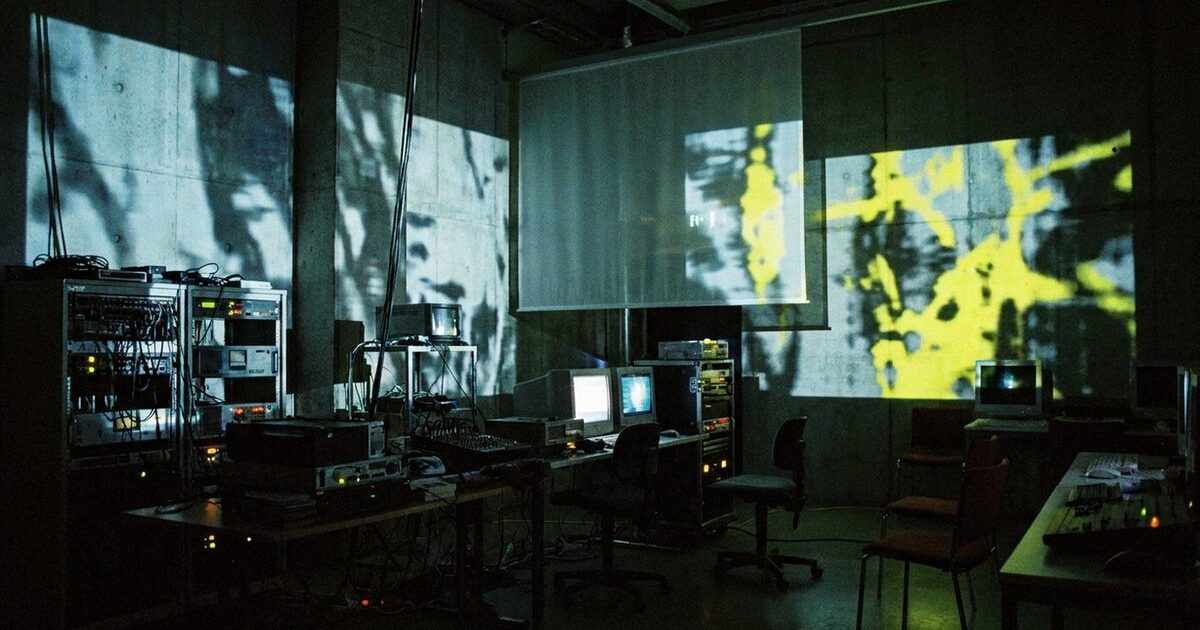
HC Gilje — Norwegian, born 1969 — has documented his own practice more rigorously than almost any other artist in Scandinavian media art. His blog at hcgilje.wordpress.com functions as both archive and critical commentary, spanning work from 1995 to the present. The trajectory runs from 160×120 pixel QuickTime loops exported on a Macintosh to large-scale spatial video installations, with a formative decade spent in live cinema through the trio 242.pilots.
Biographical Context
Gilje was born in Norway in 1969 and studied at KIT, the Trondheim Academy of Fine Arts. Before formal study he was already working with moving image — employed at the Student TV station in Trondheim, with access to a professional betacam camera he used to film QuickTime loops on a computer monitor, allowing submission to film festivals at a time when digital video had no other distribution path.
The Trondheim setting is worth noting. Not Oslo. Not Bergen. A mid-sized Norwegian city with a polytechnic culture and an experimental film community — codex film+video, the collective he joined during this period — that operated laterally, outside the main gallery circuits. The Rage video compilation series, curated by Thomas Eikrem and part of the codex programme, brought together experimental filmmakers who shared screening programs to festivals precisely because no single artist could fill a programme slot alone. That collaborative infrastructure shaped how Gilje thought about distribution from the start.
His application to KIT was submitted on a floppy disk containing one of these early video loops. He got in. He ended up studying there. The detail is not incidental — it marks the moment when experimental digital video was entering art education as a legitimate medium.
Self-Documentation as Practice
Few Nordic artists have documented their own practice as rigorously as Gilje. The blog at hcgilje.wordpress.com is not a press archive or a portfolio site. It is a working record — screening lists, technical notes, production context, retrospective analysis — running from 1995 to 2022 and beyond.
In 2023 he compiled material for a retrospective screening at Cinemateket in Oslo, part of Greg Pope’s The Dream That Kicks series on experimental film and video. Nine works, 1995 to 2022. For each, he wrote notes that explain not just what the work is but how it was made, what hardware was available, what the constraints were, and what the work looked like in its original exhibition context. This kind of documentation is genuinely rare. Most media art from the 1990s survives — if it survives at all — as a title in an exhibition catalogue and a degraded tape copy. Gilje’s record makes it possible to trace the technical genealogy of his practice in concrete terms.
The blog title is also its methodological statement: Conversations with spaces. Exploring how audiovisual technology can be used to transform, create, expand, amplify and interpret physical spaces. That sentence has not changed since the site launched. It is the governing question, and the documentation is evidence of how Gilje has answered it across three decades.
From DV and nato to Jitter/Max — Technical Genealogy
The shift from pre-rendered video to realtime processing was, for Gilje, the defining technical transition of his career. He describes it precisely in his retrospective notes:
“Between 1998 when I made H.K.mark1 and 2002 a lot of things had changed through the emergence of realtime video processing, allowing me to do transformations and layerings of video live, compared to working in photoshop and after effects. With software like nato and later jitter for Max we built our own software instruments.” (hcgilje.wordpress.com, K3)
That is the core statement. In 1998, making a five-minute video required working with five hours of raw DV footage, chopping it in a Macintosh, processing stills through Photoshop, and assembling the result. By 2002, he was building software instruments that could perform those transformations live during a performance. The tools — nato.0+55 first, then Jitter as an extension to Max/MSP — changed what was compositionally possible.
nato.0+55 was the early real-time video software developed by Netochka Nezvanova, notoriously unstable and deliberately obfuscated, but for a period the only tool that could do what Gilje needed. When nato became unsupported, Jitter (Cycling ‘74) took over. Max/MSP was already central to electronic music; Jitter extended it into visual processing. The artists working with these tools — Gilje included — were not using off-the-shelf production software. They were building instruments.
242.pilots
The realtime turn made live cinema possible. 242.pilots — Gilje, Lysakowski, and Ralske — was the trio that emerged from this new technical capacity. A video improvisation collective, performing live audiovisual material at transmediale (Berlin), CTM, MUTEK (Montréal), and across the European festival circuit in the early 2000s. The performances were improvisations. Every gig different. The software instruments they built meant the images were genuinely generated live, not triggered from a preprogrammed sequence.
The 242.pilots DVD Live in Bruxelles was released on Carpark Records in 2002. Gilje’s solo DVD Cityscapes, which includes the work Crossings from 242.pilots sessions, was released on the Paris label Lowave in 2005. Lowave is the right context here: a label committed to artists’ video and experimental cinema, distributing work that the gallery circuit alone could not reach. The Cityscapes DVD was screened at Centre Pompidou in Paris in 2006, at Cinemateque Francaise, at Museet for Samtidskunst Roskilde, and at the Electron Festival in Geneva. Physical media as distribution infrastructure — the pre-streaming model that defined how this generation’s work actually circulated.
Signature Works
Experimental video, 1995 (4 seconds)
Super8 and Hi8 recordings layered and transformed as a digital filmstrip in Photoshop. Exported as 160×120 pixel QuickTime video — the highest resolution then achievable on the available hardware. Two of these early loops were sold to NRK, the Norwegian State Broadcaster. Screened at TMV Festival 1995, Alternativ Bergen Filmklubb 1997, and as part of the Rage 4 video compilation. The work is an index of technical constraint as much as anything else — what digital video was, exactly, at that moment.
H.K.mark1 (1998, 5 min)
Footage from Hong Kong: five hours of raw material filmed with a small DV camera, processed on a Macintosh. An exploration of horizontal, vertical and mental structures in an urban landscape. The Magnetic North catalogue described it as “a kaleidoscopic visual journey through the dense urban landscape of Hong Kong, in which the artist uses a variety of layering and image manipulation techniques to achieve a graphic visual quality with references to the tradition of oriental art.” Screened at Hamburg Short Film Festival 1999, Nordisk Panorama Reykjavik 1999, Resfest (US tour, fall 1999), club.transmediale 2002, and Trondheim Kunstmuseum. H.K.mark1 represents the pre-realtime phase — intensive post-production as the only available method.
Crossings (2002, 4 min)
Created live during a 242.pilots tour. The principle: taking a small part of each video frame and building layers of fragments on top of each other, producing a collage of different time fragments. Live performance material turned into single-channel video. Soundtrack: a live remix by Justin Bennett of Silver Spider Morning by Jazzkammer. Screened at MUTEK Montréal 2002, club.transmediale 2003, the 6th Video and New Media Biennale of Santiago (Chile), Warsaw Electronic Festival, and subsequently as part of the Cityscapes DVD and programme.
Shiva (2003, 8 min)
Based on recordings from BLIND performances — a collaboration with Kelly Davis. Source footage primarily from corviale, a 1-km building outside Rome where Gilje had been invited to do a project in 2002, and from St. Petersburg (Super8 from around 1995). Live performance material transformed into single-channel work. Screened at transmediale04 (Berlin), Seoul Fringe Festival 2004, Videozone (Tel Aviv), Rencontres Paris-Berlin.
Night for Day (2004, 26 min)
Commissioned as a live performance for Randomsystem Festival in Oslo (Parkteateret), developed into an audiovisual composition in 12 parts. Material shot and recorded in Tokyo, described at the time as “expressionist impressions from an urban reality, 12 audiovisual poems assembled into a surreal whole.” Collaboration with Jazzkammer (Lasse Marhaug and John Hègre), a noise duo with whom Gilje had toured in Europe and Japan in the early 2000s. Night for Day was the last of his videos focused on urban environments. Released with H.K.mark1, Crossings, and Shiva as the Cityscapes DVD on Lowave. Screened at The Norwegian Shortfilm Festival 2004, Eyes for Other Skies (Next Wave Festival, Melbourne) 2004, Cinemateque Française (Paris), and as part of subsequent Cityscapes screenings internationally.
Exhibition Record and Venues
The screening record documented on hcgilje.wordpress.com spans four continents. The core European circuit — transmediale (Berlin), CTM, MUTEK, Electron Festival (Geneva), Diagonale (Graz), Warsaw Electronic Festival, Seoul Fringe — reflects the festival infrastructure through which experimental video and live cinema circulated in the 2000s. Not the contemporary art biennial circuit. Not the commercial gallery system. A parallel structure of media art festivals, experimental film programmes, and university-adjacent venues.
Selected documentation from K3 (hcgilje.wordpress.com):
- TMV Festival, Trondheim, 1995
- Alternativ Bergen Filmklubb, 1997
- Urban Experiences program, Circles of Confusion / Volksbühne Berlin, November 1998
- Kortfilmfestivalen i Grimstad, 1999
- Hamburg Shortfilmfestival, 1999
- Kurzfilmtage Winterthur, 1999
- Nordisk Panorama, Reykjavik, 1999
- Magnetic North, UK tour, fall 1999 – spring 2000
- Resfest, US digital festival tour, fall 1999
- club.transmediale_02, Berlin, February 2002
- MUTEK, Montréal, 2002
- CTM.03
- Diagonale festival / Medienturn Graz, 2003
- 6th Video and New Media Biennale, Santiago, Chile
- Warsaw Electronic Festival
- Filmform at Fylkingen, Stockholm, 2004
- Seoul Fringe Festival, 2004
- Random System Festival (premiere Night for Day), Oslo, 2004
- The Norwegian Shortfilm Festival, 2004
- Eyes for Other Skies (Next Wave Festival), Melbourne, 2004
- Videozone, Tel Aviv, 2004
- Rencontres Paris-Berlin, 2004
- Cityscapes screening at 11-art.com, Beijing, 2005
- Lowave screening at Centre Pompidou, Paris, 2006
- Lowave screening at MK2 Beaubourg, Paris, 2006
- Trondheim Kunstmuseum (Magnetic North program), 1999
- HARDfilms: pixels and celluloid, Kino Arsenal Berlin, 2007
- Erranti / Wanderers in contemporary video art, Palazzo Pubblico, Siena, 2008
- Programmer le temps: 50 ans d’art numérique, Illuminations, Galerie G, Paris, 2010
- Cityscapes / Reframing Reality, Museet for Samtidskunst Roskilde, November 2010 – February 2011
- Cityscapes screening, Electron Festival, Geneva, 2011
- Total City, Institut Valencià d’Art Modern, May–July 2012
- Retrospective screening, Cinemateket, Oslo, September 2023
This is the documented record from K3, not a comprehensive career list. The truncated portion of the blog likely contains later installation venues not captured here. What is confirmed: a consistent presence on the experimental video and media art circuit from 1995 through at least 2023, across Europe, North America, and Asia.
Gilje on Realtime vs Pre-rendered
The distinction between pre-rendered and realtime is not merely technical for Gilje — it is the pivot around which his practice reorganised itself. The 1998–2002 transition he describes is worth dwelling on.
Before: five hours of footage to make five minutes of video. Intensive selection, transformation in Photoshop, linear assembly. The work was fixed before it left the studio. After: software instruments capable of live transformation, layering in real time, improvisation with visual material during performance. 242.pilots was only possible because of this shift. The live performances were “always improvisations, so could be very different from each gig.”
The recorded performances then became raw material for single-channel works. Shiva was built from 242.pilots BLIND performance recordings. The loop between live performance and studio editing is characteristic — Gilje was not choosing between performance and installation but cycling between them, with each mode feeding the other.
His blog title — Conversations with spaces — points toward the later installation work, where the question shifts from “how do you make an audiovisual composition” to “how does projected light change the experience of a physical room.” That is a different problem. It requires different instruments. The technical genealogy from DV to nato to Jitter runs parallel to a conceptual development from single-channel video to spatial installation — both changes are documented, both connected.
Frequently Asked Questions
Who is HC Gilje?
HC Gilje is a Norwegian video and media artist born in 1969. He studied at KIT, the Trondheim Academy of Fine Arts, and began making experimental digital video in 1995. His practice spans single-channel video, live cinema performance, and spatial video installation. He is a member of the live audiovisual trio 242.pilots (with Lysakowski and Ralske) and maintains one of the most complete self-documented career records in Scandinavian media art through his blog at hcgilje.wordpress.com.
What was 242.pilots?
242.pilots was a live cinema trio — HC Gilje, Lysakowski, and Ralske — that performed extensively on the European and international new media art festival circuit in the early 2000s. Their performances were fully improvised, using software instruments built around nato.0+55 and later Jitter/Max to process and transform video material in real time. The group released Live in Bruxelles on Carpark Records in 2002. Gilje’s solo DVD Cityscapes (Lowave, 2005) includes material created during 242.pilots sessions.
What software does Gilje use in his work?
Gilje’s documented tool stack has evolved across his career. In the mid-1990s: Photoshop for frame processing, QuickTime as export format. From the late 1990s: nato.0+55 for real-time video processing, then Jitter (an extension to Max/MSP, developed by Cycling ‘74) as nato became unsupported. Gilje describes building “our own software instruments” with these environments. Max/MSP and Jitter remained the primary real-time tools through the 2000s and into his installation work. Earlier in the timeline he also used After Effects for pre-rendered post-production.
Where can I see documentation of Gilje’s works?
The primary source is hcgilje.wordpress.com, Gilje’s own blog and archive, which includes screening lists, technical notes, production context, and retrospective analysis going back to 1995. It is the most complete self-documented record in Scandinavian media art of this generation. The Cityscapes DVD (Lowave, 2005) provides an accessible entry point to the single-channel work. For the broader context of Norwegian new media art, the we-make-money-not-art.com interview archive includes documentation of the Atelier Nord context in which Gilje and his contemporaries worked.