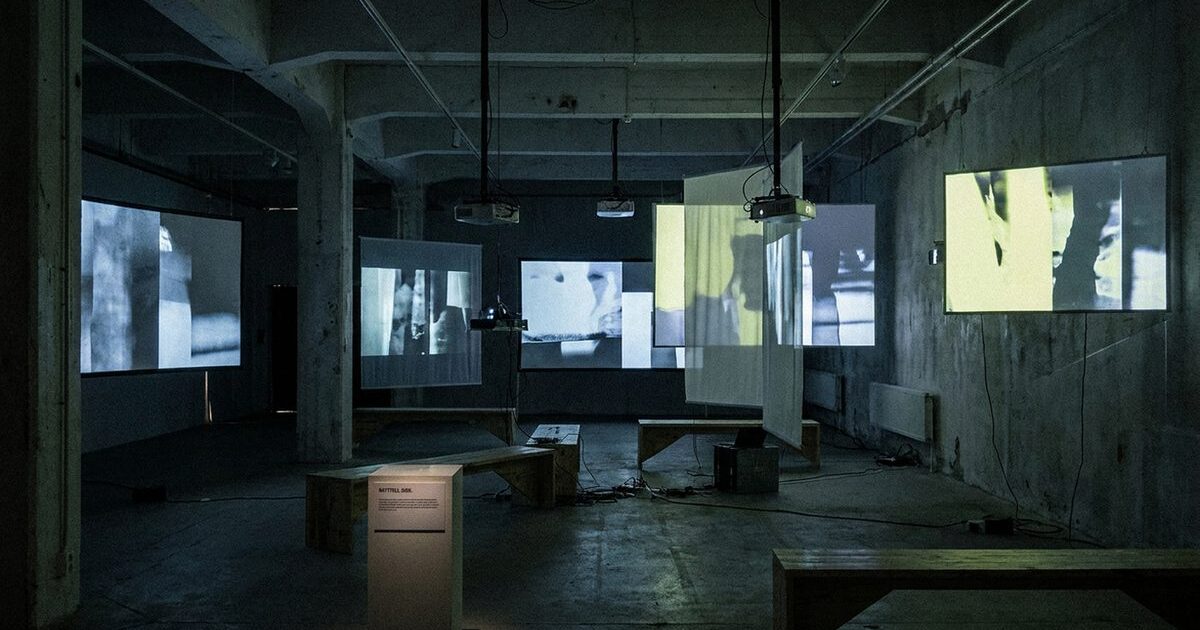
Eija-Liisa Ahtila (Finland, born 1959) is the most internationally recognised artist of the Scandinavian new media mid-generation. Based in Helsinki, she built a practice around multi-screen video installation that is inseparable from the politics of where and how moving image is shown. Her work runs from feminist psychological portraiture in the early 2000s to post-humanist inquiry into biopolitics, animals, and the limits of the anthropocentric camera.
Biographical Context
Ahtila trained as a painter in Helsinki, then followed the moving image into two different institutional worlds — and never fully chose between them.
She graduated from the art school in Helsinki. Painting lasted roughly a year before film took over. “I painted for one year, and did some installations, conceptual art, etc., but film felt like an interesting medium, and it just took over.” (K6, Kunstkritikk interview) A year in London followed. After returning to Helsinki, she made the first work in what would become her characteristic mode.
Then UCLA. She and her husband spent 1994 and 1995 in Los Angeles, where she studied film. They were certain they would return to California permanently — they stored belongings in a friend’s attic. What kept her in Helsinki was practical: project funding materialised, and a dog. “We got financing for our projects, and I got a dog.” (K5, Arterritory interview) Helsinki was not a sentimental attachment. It was a functional base.
Her career broke internationally in the 1990s. The Hans Ulrich Obrist-curated exhibition Nuit Blanche (1998, Paris) was part of a moment when Nordic contemporary art drew sudden European attention. Ahtila is characteristically ambivalent about what that moment meant: “It’s hard for me to judge since that was a time of new opportunities for me outside of Finland.” (K5) She describes it through specific encounters — meeting Pierre Huyghe, Shirin Neshat, Aernaut Mik — not through a sense of regional pride.
Since then: Venice Biennale (48th and 51st editions), dOCUMENTA, solo exhibitions at MoMA New York and MoMA San Francisco, retrospectives at Jeu de Paume Paris and Tate Modern London. Currently represented by Marian Goodman Gallery in New York and Paris, and by Charlotte Lund gallery in Stockholm.
The Multi-Screen Turn — Why the Installation Is the Work
The multi-screen format was not a technical experiment. It was a structural argument about what film can do to a viewer’s position in space.
The origin is specific: studying film in the United States, Ahtila saw large divided billboard advertisements — still images split across multiple panels. She asked what would happen with moving images. Then she saw a Gary Hill exhibition. The two things combined. Her first systematic use of the technique was If 6 Was 9 (1995), made in Stockholm for a solo exhibition. “There I really used the technique for telling a story for the first time. I had to learn everything in and by making it.” (K6)
What the installation format makes possible is a redistribution of the filmic event. Rather than a single screen that fixes the viewer at a calculated distance, multiple simultaneous projections position the viewer inside the work. The event is happening around them, not in front of them. Ahtila has continued to explore what happens when the film is situated in different places — spatially divided and then reassembled by viewer movement through the room.
She has always also made single-channel versions for conventional film distribution. The Annunciation (2010) exists in two versions: one single-image, one three-image side by side. Which format works best depends on the specific work. There is no rule. The preference is unambiguous: “The films I make are at their best in museums and on multiple screens. There is not just one system.” (K6)
Signature Works
The House (2002)
Made after extensive research and interviews with women who experience psychological disturbances — hearing voices, hallucinations. The result is a work with what the Arterritory interview describes as a “strange, magnetic mood,” achieved through controlled colour use (forest-green, grey, wine-red) and a story that moves between interior and exterior reality without explaining where the boundary is. The multi-screen format enacts the psychological condition: events that seem impossible in spatial logic become plausible when they can happen simultaneously in different parts of a room.
Where Is Where? (2008)
A work about a true incident from the Algerian Civil War: two thirteen-year-old Algerian boys who killed a French friend. The source is Franz Fanon’s The Wretched of the Earth (1961). Ahtila’s reading is explicitly about European complicity and the gaps between cultures. “This was not just about French and Algerian history; it was European history as well, and our own.” (K6) The work premiered at Jeu de Paume in Paris in 2008. Outside the exhibition space, nationalists demonstrated against it. Ahtila’s framing of the work’s question is precise: “How could a Scandinavian woman understand this, how can she even imagine that she does? But this is actually the question of the work.” (K6) Where Is Where? is held in the Kiasma Collections.
The Annunciation (2010)
Ahtila’s version of the biblical subject. Three-channel projected installation, 28 minutes 20 seconds, synchronized HD files (original format 35mm negative and HD), 16:9 ratio, Dolby Digital 5.1. It won the Arte award for best European film at Oberhausen. Also shown at Venice Film Festival Orizzonte series and at Edinburgh and Milan film festivals. The two-context experience was instructive: at Venice, following action-based competition programming, it felt wrong. At Oberhausen, with a different audience disposition, it won. “Contexts are important.” (K6)
The Fir Tree Installation (Parallel Worlds, Kiasma 2013)
A moving image installation of a fir tree — filmed vertically on six screens spanning two rooms, its branches moving in wind, the tree appearing crooked, stuffed into the architectural space. The argument: recording technology cannot show a standing tree in its full vertical dimension. “Even technology is so anthropocentric that it is not possible to normally film a tree and show it in its full size.” (K5) The post-humanist turn in Ahtila’s recent work — away from human psychology, toward the non-human world — is here at its clearest.
Ahtila on the Politics of Exhibition Format
This is the section of Ahtila’s practice that most consistently gets flattened in critical coverage. She is described as a video artist, a film artist, a media artist. Each label is accurate and each misses what she has actually said about the institutional stakes of distribution.
The Kunstkritikk interview (K6), conducted before the Parallel Worlds opening at Kiasma in 2013, is structured precisely around this question. The interviewer notes that in Nordic countries Ahtila is often seen as a media artist but suggests the work is better understood as political. Her response reframes the premise: “The moving image is a medium that in our society is most used to describe and reveal something about our society and world, and so it is very political by nature. What should be shown and in what way?” (K6)
The politics are not separable from the format. A work shown at a film festival and the same work shown on six screens in a museum are, in Ahtila’s account, different works — not identical content in different packaging. The audience orientation is different. The attention structure is different. The architecture of reception is different. She experienced this directly at Venice: the same film that won at Oberhausen felt wrong in the competition programme context. “I was shocked while I saw my film there.” (K6)
This is more than an artist’s preference for one venue over another. It is an argument that the politics of a work depend on the conditions under which it is received. The Annunciation on three screens surrounding the viewer creates a different relationship to the Algerian Civil War material than the same footage in a cinema seat. Installation is not decoration. It is the argument.
In Finland, she argues, the institutional separation between art world and film world creates absurdities: “In a small country like Finland it is absurd that people can ignore films just because they are shown in the ‘wrong’ institution.” (K6) The gatekeeping between film culture and contemporary art culture is, in her view, a political failure — one that costs works the audiences they need.
The Parallel Worlds exhibition was organised jointly by Kiasma and Moderna Museet in Stockholm, touring from Carré d’Art in Nîmes to Stockholm to Helsinki. That institutional collaboration — two major Nordic contemporary art museums coordinating a touring retrospective — is precisely the kind of structure her argument requires.
Critical Reception and Institutional Context
The Parallel Worlds retrospective at Kiasma in 2013 was the most concentrated institutional presentation of Ahtila’s work in Finland. Kiasma — the Finnish Museum of Contemporary Art in Helsinki, opened 1998 in a Steven Holl building — has been the primary Finnish institutional home for her practice, including the permanent collection holding of Where Is Where? (2008). The Moderna Museet connection is significant: Stockholm’s national museum of modern and contemporary art initiated the Parallel Worlds tour and is one of the few Nordic institutions with the spatial infrastructure to show large multi-channel works at scale.
The MoMA presentations and the Jeu de Paume retrospective placed her in the American and French institutional canons that still largely determine international critical standing for non-US artists. The pattern is of an artist whose work moved through the major European and American institutions not as a survey of a resolved career but as an ongoing argument about form.
Critical response has consistently struggled with the category question. Is this film? Is this installation? The Kunstkritikk interview is partly a record of that struggle: the interviewer wants to call it political, Ahtila wants to say the medium itself is already political. What gets missed is the specificity of the installation format as an argument about viewer position — something that requires actual spatial encounter to evaluate.
For wider context on the institutions that shaped this generation of Nordic new media artists, see Scandinavian New Media Artists — Generation Portraits 1990–2010.
Ahtila’s Approach to Narrative and Disruption
A recurring feature of Ahtila’s work is research-based grounding combined with formal disruption. The House came from interviews with women experiencing psychological disturbances. Where Is Where? came from Fanon. The Annunciation comes from a Biblical text submitted to a contemporary post-humanist reading. In each case, the source material is treated as a problem to be worked through spatially, not illustrated.
The sci-fi adaptation trilogy from 2005 to 2008 makes this most explicit. Three works, three canonical science fiction texts: Bellona (after Samuel R. Delany, 2005), Crystal World (after J.G. Ballard, 2006), Left Hand of Darkness (after Ursula K. Le Guin, 2008). These are not adaptations in the conventional sense — they use the source texts as frameworks for spatial and perceptual problems: time, gender, cognitive estrangement, the breakdown of stable categories. All three are formally demanding: they require sustained attention in the installation space, without the narrative momentum cinema conventionally provides.
Ahtila’s interest has shifted, in more recent work, from human psychological interiority toward the relationship between humans and the non-human world. Technology that cannot film a tree vertically is not a neutral recording tool. It is a political instrument of a worldview. Making that visible is, in her account, a political act.
Frequently Asked Questions
Who is Eija-Liisa Ahtila?
Eija-Liisa Ahtila (born 1959) is a Finnish artist based in Helsinki, internationally recognised as a pioneer of multi-screen video installation and art film. She trained as a painter in Helsinki before moving to film, studied at UCLA (1994–95), and has been represented by Marian Goodman Gallery since the late 1990s. Her work has been shown at Venice Biennale (48th and 51st editions), dOCUMENTA, MoMA New York, MoMA San Francisco, Jeu de Paume Paris, and Tate Modern London.
What are multi-channel video installations?
Multi-channel video installations use multiple simultaneous video projections or screens arranged in a space so that the viewer is surrounded by or positioned within the work, rather than facing a single screen. Ahtila uses multiple channels to distribute a narrative across space: events happen simultaneously on different screens, viewers move through rather than watch, and the architecture of the room becomes part of the work. If 6 Was 9 (1995) was her first systematic use of the format.
How does Ahtila approach narrative in her work?
Ahtila begins with research — interviews, texts, historical incidents — and then submits that material to formal disruption. The House (2002) came from interviewing women with psychological disturbances; the installation format enacts rather than describes their experience. The sci-fi trilogy (Bellona 2005, Crystal World 2006, Left Hand of Darkness 2008) adapts Delany, Ballard, and Le Guin not to retell their stories but to use them as frameworks for spatial and perceptual problems. Narrative is a means, not an end.
Where can Ahtila’s work be seen in collections?
Where Is Where? (2008) is held in the Kiasma Collections at the Finnish Museum of Contemporary Art in Helsinki. Ahtila’s work has been exhibited at MoMA New York and San Francisco, Tate Modern London, Jeu de Paume Paris, Moderna Museet Stockholm, and Carré d’Art in Nîmes. She is represented by Marian Goodman Gallery (New York and Paris) and Charlotte Lund gallery (Stockholm).