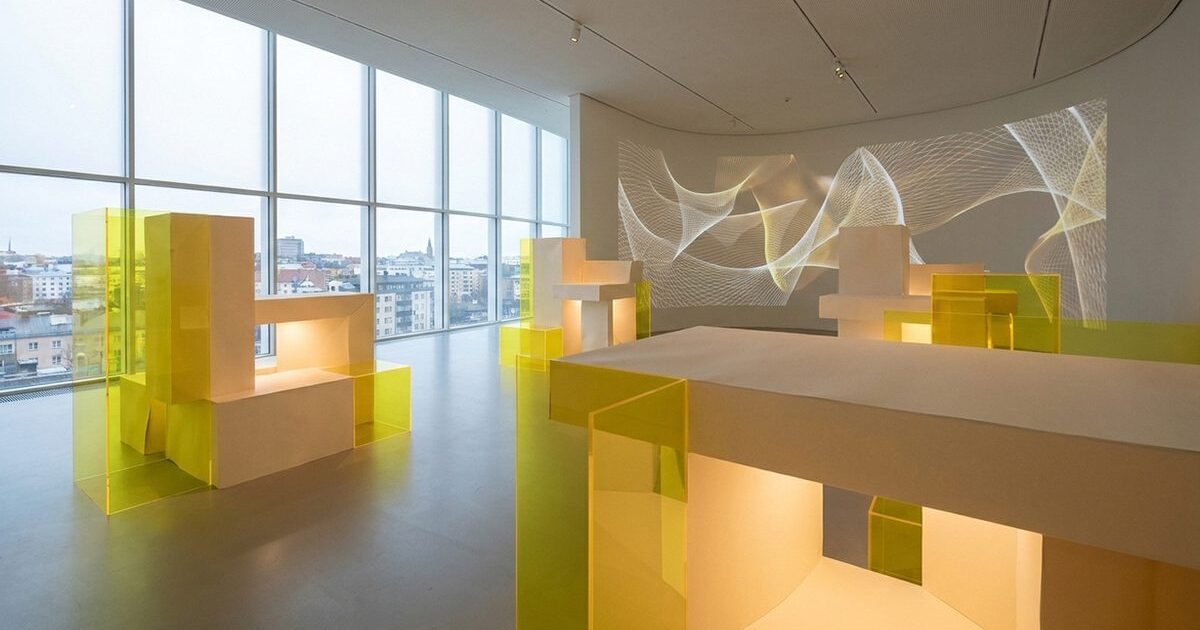
Ann Lislegaard (Norway, b. 1962) has been making spatial installation and 3D animation since the late 1990s. Her work is held by Astrup Fearnley Museet in Oslo. The practice sits at the intersection of architectural thinking, science-fiction literature, and the phenomenology of language — a combination that does not fit neatly into any single category of media art, which is probably the point.
Biographical Context
Lislegaard was born in Norway in 1962 and trained as a sculptor — a background that continues to determine how she thinks about space, even when the space is computer-generated.
The sculptural training shows up in the material logic of her work. Where a painter builds up surfaces, a sculptor removes material, rearranges volume, pays attention to how a form sits inside a larger environment. Lislegaard has transferred that sensibility into 3D animation and architectonic intervention: the space in her installations is always specific, always structured, never merely a backdrop for image or sound.
She belongs to the Norwegian generation of media artists who came to prominence in the 1990s and 2000s, alongside figures like HC Gilje and Per Platou, within a small but well-funded infrastructure for experimental art in Oslo. Astrup Fearnley Museet — the private contemporary art museum on Tjuvholmen — holds her work in its collection. That institutional relationship matters: it places Lislegaard in a collecting context, not just an exhibition circuit, which is the distinction between an artist who is seen once and an artist whose work is preserved.
Her base is Oslo. Her gallery in New York was Murray Guy. The international circuit for this kind of work runs through gallery representation, institutional commissions, and the festival and biennial network — all three of which Lislegaard has operated across.
3D Animation and Spatial Narrative
The central question in Lislegaard’s practice is perceptual: how does an individual experience herself inside an expanded concept of reality?
3D animation, in her hands, is not a special effect. It is an architectural argument. She builds spaces — stripped-down, abstracted, deliberately spare — and then places either a human figure or a voice inside them, and watches what happens to orientation, to self-perception, to the relationship between body and built form.
The Astrup Fearnley’s characterisation of her work is worth quoting directly: her art is typified by “constructive relativization, frequently with an absence of imagery.” The finished piece is explicitly not her primary concern. She is interested in breaking down structure. That is an unusual position for a visual artist to take — most work toward resolution, toward the completed object. Lislegaard works toward the undoing of the conventional perceptual frame.
Language is central to this. Repetition, loops, superimposed voices, heteroglossia — the technical term for the coexistence of multiple voices or registers within a single text — are recurrent formal devices. The texts in her installations are often drawn from literary works, specifically science fiction. The loop structure means the work resists narrative closure: there is no beginning and no end, only re-entry points.
Light functions similarly. In several works, coloured light pulses, shifts, or tracks movement in ways that map the space without illustrating it. The light does not decorate the architecture; it is part of its argument.
Signature Works
Three works from the first decade of the 2000s define the core of Lislegaard’s practice: a 3D animation piece examining perception and constructed reality, a sound-and-light installation reframing Ibsen, and a science-fiction trilogy that is still the most referenced body of work from her career.
Double Vision (2004) is the clearest demonstration of her 3D-animation method. A woman is filmed moving through a constructed three-dimensional world. The architecture is stripped down — bare rooms, emphatic geometry, no furniture, no distraction. The point of that simplicity is to isolate the movement of light across surfaces. The “real” woman inside the constructed space produces what the Astrup Fearnley describes as “a prevailing fascination with how an individual perceives herself in relation to an expanded concept of reality.” That sentence is abstract. The work is not: you see exactly what happens when a human body encounters a space that has been built specifically for the camera.
Slamming the Front Door (after A Doll’s House) (2005) is a sound and light installation. Four different female voices move around the room, each repeating the line “She is slamming the front door.” Pulsating coloured light underpins the motion of the voices. The source is Ibsen’s Nora — the moment at the end of A Doll’s House when she walks out. Lislegaard’s version holds that single moment in a loop: the door is always being slammed, the act never completed, the exit perpetually deferred. Four voices because the “she” of Ibsen’s text is not one woman but many. Heteroglossia as feminist reframing. It is one of her most formally concentrated pieces.
The science-fiction trilogy (2005–2008) is her most sustained project and the body of work most likely to appear in any institutional account of her practice. Three installations, each adapting a canonical science-fiction novel:
- Bellona (after Samuel R. Delany) (2005): a 3D animation of Delany’s fictional city Bellona from his 1975 novel Dhalgren, exploring a perceptual architectonic environment and the disorientation of conventional spatial orientation. Shown at the 2015 Voyage to the Virtual exhibition at Scandinavia House, New York, curated by Tanya Toft. The exhibition listing notes: “3D animation of writer Samuel R. Delany’s fictional city Bellona, that explores a perceptual architectonic environment, calling attention to the recent expansion of our sense of space and place through computer-rendered virtual environments.” Runtime: 11 minutes. Courtesy Murray Guy, New York.
- Crystal World (after J.G. Ballard) (2006): a three-dimensional world in gradual transformation. The visual framework is based on Oscar Niemeyer’s Ciccillo Matarazzo Pavilion in São Paulo, furnished with identifiable modernist artworks. The connection to Brazilian modernism is deliberate — the Astrup Fearnley reads it as “a commentary on European modernism, which, for all its visions of a better world, merely extended a form of imperialism.” Brasilia as utopian vision; 3D construction as its digital equivalent.
- Left Hand of Darkness (after Ursula K. Le Guin) (2008): the final work of the trilogy, engaging Le Guin’s novel directly for its treatment of gender ambiguity and social organisation. Together with the Delany and Ballard works, it forms a sustained argument about time, gender, and cognitive estrangement in Darko Suvin’s sense of the term.
Darko Suvin’s definition of science fiction as “a literary genre for cognitive estrangement” — in which the reader is transposed to an alternative reality that is both recognisable and unprecedented — is the theoretical framework Lislegaard explicitly invokes. It is a precise formulation. Cognitive estrangement is not disorientation for its own sake; it is the methodical removal of familiar coordinates in order to perceive what those coordinates normally conceal.
Time Machine (2011) continues the science-fiction strand, based on H.G. Wells’ novella. The Astrup Fearnley describes it as “a critical reflection on existing systems of communication.” Advanced 3D technology; complex universe; “non-thematic interpretations of themes touched on in these literary works” — a formulation that signals Lislegaard is not illustrating her sources but using them as structural material.
Collection and Exhibition Record
Astrup Fearnley Museet holds Lislegaard’s work and maintains an institutional artist profile as part of its collection documentation. The profile — which is one of the more complete structured records available for any Norwegian media artist of her generation — is the primary source for the biographical and works data in this article.
The touring exhibition Parallel Worlds — organised by Kiasma, Helsinki’s Museum of Contemporary Art, and Moderna Museet in Stockholm — was shown in Stockholm before travelling to Carré d’Art in Nîmes, France, and then to Kiasma. Lislegaard’s video installations have been shown in the Kiasma context, placing her within the same institutional circuit as Eija-Liisa Ahtila, whose retrospective was anchored by the same programme. The Moderna Museet link is confirmed through this touring exhibition record.
In 2015, Bellona (2005) was included in Voyage to the Virtual at Scandinavia House, New York — an exhibition of Nordic digital, moving image, and light-based art curated by Tanya Toft and organised by the American-Scandinavian Foundation. The participating artists included Katja Aglert, Per Platou, Jacob Tækker, Olafur Eliasson, and others, placing Lislegaard squarely within the documented Nordic digital art circuit of the mid-2010s.
Gallery representation: Murray Guy, New York (confirmed in K7 exhibition credits). Historical representation by Galleri Nicolai Wallner in Copenhagen is noted in secondary sources but not confirmed in the primary sources used for this article.
Methodological Approach — Science Fiction and the Architectural Frame
The science-fiction strand in Lislegaard’s practice is not decorative. It is structural. Sci-fi, as Suvin’s framework establishes, is one of the few popular genres that takes seriously the instability of categories — time, gender, species boundary, spatial orientation — that most cultural forms treat as fixed. Lislegaard uses the genre’s formal licence to do something that straightforward architectural or installation work cannot easily do: put the viewer inside a space that has been explicitly constructed to be cognitively unreliable.
Her sculptural training gives the architectural element its precision. The stripped-down rooms of Double Vision, the Niemeyer-derived volumes of Crystal World, the Bellona cityscape — these are not generic digital environments. They are designed spaces, with specific historical and conceptual references. The 3D rendering technique makes those references available at a remove: you are not inside the Ciccillo Matarazzo Pavilion, you are inside a version of it, running at exhibition pace, looping.
Sound and language carry the conceptual argument where image alone cannot. The four female voices of Slamming the Front Door, the repeated line, the refusal of a single authoritative voice — these formal choices enact heteroglossia rather than describing it. The method is consistent across the body of work: formal devices that do not explain the concept but produce it as an experience.
What connects Lislegaard to the broader generation of Scandinavian new media artists working in the 1990s and 2000s is not just institutional circulation but a shared confrontation with the question of what 3D environments and digital space can do that physical space cannot. Her answer is more literary than most — Delany, Ballard, Le Guin, Ibsen, Wells. The archive she draws from is not the history of digital art but the history of speculative fiction. That is a distinguishing move.
For the institutional and generational context of this practice, see the hub article on Scandinavian New Media Artists 1990–2010. For the archival record of the Electrohype biennale context in which artists of this generation circulated, see Nordic New Media Art History.
Frequently Asked Questions
Who is Ann Lislegaard?
Ann Lislegaard is a Norwegian post-conceptual artist born in 1962, working in spatial installation, 3D animation, and architectonic intervention. She trained as a sculptor and is based in Oslo. Her work is collected by Astrup Fearnley Museet. She is best known for a trilogy of science-fiction-derived installations created between 2005 and 2008, adapting novels by Samuel R. Delany, J.G. Ballard, and Ursula K. Le Guin, and for earlier works exploring language, heteroglossia, and constructed space.
What are Lislegaard’s signature works?
The core body of work includes Double Vision (2004), a 3D animation placing a filmed woman inside a stripped-down constructed architecture; Slamming the Front Door (after A Doll’s House) (2005), a sound and light installation using four female voices and looped Ibsen text; and the science-fiction trilogy Bellona (after Samuel R. Delany) (2005), Crystal World (after J.G. Ballard) (2006), and Left Hand of Darkness (after Ursula K. Le Guin) (2008). Time Machine (2011), based on H.G. Wells, continues the sci-fi strand.
How does science fiction influence Lislegaard’s practice?
Lislegaard draws on Darko Suvin’s definition of science fiction as “a literary genre for cognitive estrangement” — a mode that transposes the reader to a reality that is both recognisable and unprecedented. She uses science-fiction novels as structural frameworks rather than as illustrative sources, building 3D environments that do not depict the source novels but enact their conceptual concerns: unstable spatial orientation, gender ambiguity, the relationship between utopian vision and its consequences. The sci-fi frame gives her formal licence to make the viewer’s perceptual coordinates unreliable in ways that straight architectural installation cannot easily achieve.
Which museums hold Lislegaard’s work?
Astrup Fearnley Museet in Oslo holds Lislegaard’s work in its collection and maintains an institutional artist profile. Her installations have been shown in the context of Kiasma (Helsinki’s Museum of Contemporary Art) and in the touring programme that included Moderna Museet in Stockholm. In 2015, Bellona (2005) was exhibited at Scandinavia House in New York as part of the Voyage to the Virtual exhibition curated by Tanya Toft.