Malmö is Scandinavia’s densest artist-run media art ecosystem — seven or more independently identified spaces in a city of around 350,000 residents. The Öresund Bridge, open since 2000, put the city in a thirty-minute corridor to Copenhagen and reshaped its cultural geography permanently. The Rooseum’s transition to Moderna Museet Malmö in 2009 was the institutional watershed. What followed was not institutional growth — it was a proliferation of self-organized space that no single funding decision could dismantle.
Why Malmö? Geography, Funding, and the Öresund Gradient
Malmö’s media art infrastructure is not accidental. It is the product of a specific geography, a particular funding era, and a generation of artists who arrived in the 1990s and chose to stay.
The Öresund Bridge changed the logic of the city. When it opened in July 2000, Malmö stopped being a terminal point and became a crossing. Copenhagen was suddenly accessible by train in under thirty minutes. The combined Öresund region — roughly 3.9 million people spanning southern Sweden and eastern Denmark — became an informal cultural zone. International artists applied to Malmö residencies because Copenhagen was nearby. Copenhagen curators attended Malmö openings because the commute was shorter than many within-city journeys. This permeability is structural, not incidental.
Malmö’s expansion as an art city ran parallel to the university boom. Malmö University was established in 1998, the same year the city was completing its post-industrial transition from shipbuilding and manufacturing. Malmö Art Academy — part of Lund University’s Faculty of Fine and Performing Arts, located physically in Malmö — produced a generation of artists in the early 2000s who entered an infrastructure that included the Rooseum under Charles Esche, the growing artist-run sector, and the Öresund’s European connectivity. Many of those artists stayed. That retention is the foundation of the current scene.
Swedish arts funding — through the Swedish Arts Council, Region Skåne, and the City of Malmö — provides a structural floor that makes artist-run organizing viable. Spaces like Signal, Celsius Projects, and Trumpeten are not sustained on commercial revenue. They operate through a mix of public grants, studio income, and collective labor. When the funding floor holds, the ecology flourishes. When it shifts — as with Elastic’s departure to Stockholm in 2015 — the scene reorganizes rather than collapses.
The Rooseum Decade (2000–2006): Esche and the Institutional Inflection
The Rooseum under Charles Esche was the moment Malmö entered the international contemporary art conversation. That period ended. What it left behind matters more than the institution itself.
Charles Esche directed the Rooseum from 2000 to 2006. The Rooseum had operated as a contemporary art centre in Malmö since the late 1980s — founded by collector and businessman Fredrik Roos — but Esche’s tenure is the period that produced genuinely international programming and cemented the institution’s reputation. Kalle Brolin’s 2015 analysis in La belle revue is precise on this: the Rooseum era, combined with Malmö Art Academy’s international network and the presence of gallery Elastic, constituted the infrastructure for a generation of Malmö-based artists building international careers.
Esche left in 2006. He subsequently became director of the Van Abbemuseum in Eindhoven. The Rooseum did not survive his departure with the same institutional energy. In late 2009, Moderna Museet Malmö took over the Rooseum’s facilities in the Gasverksgatan building — a former power station adapted for art. The transition was significant. Moderna Museet Malmö is an offshoot of the national museum of modern art in Stockholm. It combines contemporary programming with exhibition of the large Stockholm collection. The curatorial agenda shifted: less experimental, more institutional in the established sense.
What Esche’s decade left was less tangible than an institution. It left a network of artists who had experienced serious international programming at close range, an expectation that Malmö could operate at that level, and the organizational habits that come from watching an institution work. The artist-run explosion of the 2010s is not unrelated to the Rooseum decade — it is, partly, a response to its end.
Moderna Museet Malmö and Malmö Konsthall: Institutional Anchors
Both institutions provide exhibition infrastructure that media and digital artists use. Neither was built for that purpose.
Moderna Museet Malmö occupies the former Rooseum building and has been programming contemporary art since its opening in 2009. The museum’s character is defined by its dual mandate: showing the Stockholm collection and producing new exhibitions. In 2014, it hosted Modernautställningen — the quadrennial survey of Swedish contemporary art — for the first time in Malmö rather than Stockholm, a genuinely significant institutional move. The survey’s curators chose a thematic format centered on artists from the Baltic Sea region, departing from the traditional nationalist survey model. That decision signals something about Malmö’s self-image: a Baltic and European city, not a provincial Swedish one.
Malmö Konsthall is a different institution with a different logic. Free entry, pavement-level accessibility, a spacious restaurant that functions as an informal meeting point for the local arts community. The Konsthall has historically supported experimental work, and its accessibility — physical and economic — makes it a genuinely public space rather than a curated exclusion zone. For the Electrohype biennials, which ran from 2000 to 2010, Malmö Konsthall was among the primary venues for new media and computer-based art. That history is not decoration — it is why Malmö Konsthall appears in the documentation of Swedish new media art history at all.
Neither the Konsthall nor Moderna Museet Malmö is a media art institution in the specialist sense. They are general contemporary art spaces that have, at different times, made room for media and digital practices. The institutional anchor function they provide is real but permissive rather than dedicated.
The Artist-Run Network: Signal, Celsius, Alta, Canopy, Trumpeten, Hangaren
Malmö has an infrastructure reality that other Nordic cities of comparable size simply do not have: more artist-run spaces per capita than any city in this comparison.
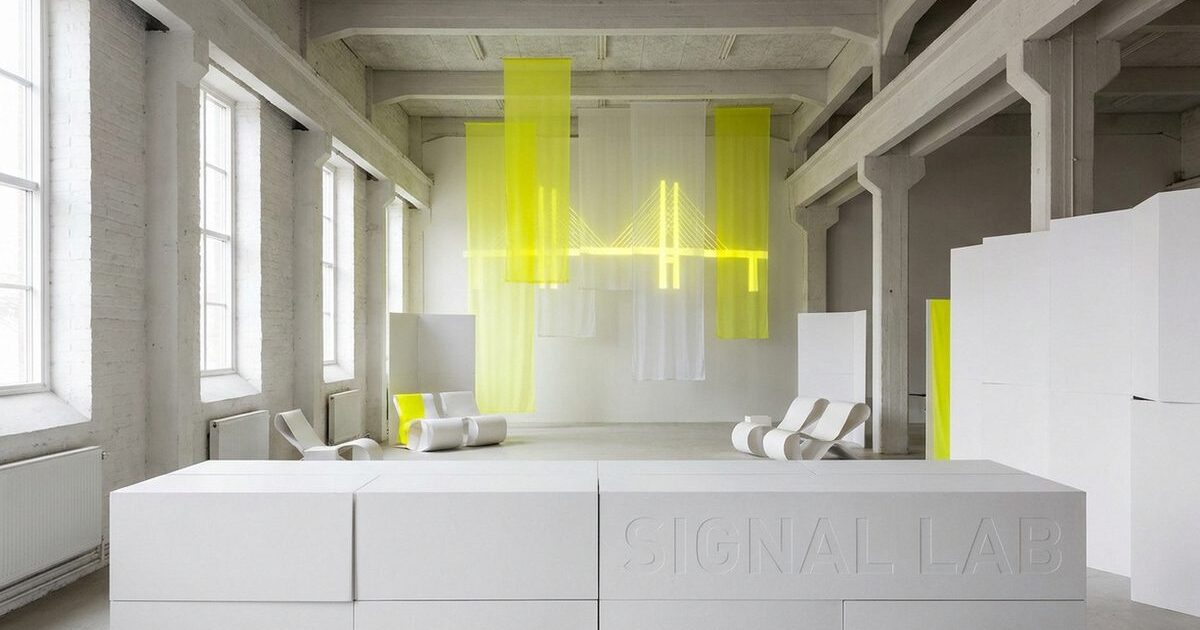
Signal — Centre for Contemporary Art — is the most internationally visible of the Malmö artist-run spaces. Signal has built a reputation for exhibitions that are conceptually serious and formally ambitious. Its programming has included artist talks and method seminars that function as intellectual infrastructure for the wider local scene, not just programming for external audiences. In 2015, Kalle Brolin noted that Signal was operating from temporary locations while searching for a permanent site — a precarious position. That kind of improvisation is characteristic of the sector.
Celsius Projects is a studio collective with an exhibition programme. During the 2021 Gallerihelg — the annual gallery weekend that drew over 70 participating spaces across the city — Celsius mounted the third part of its series Something About the Realities We Share and the Realities We Don’t, showing VR work by Rut Karin Zettergren alongside handwoven textile and video by Matilde Westavik Gaustad. The combination is representative: analog and digital media in genuine conversation, not hierarchy.
Alta Art Space operates from a former ketchup factory on Celsiusgatan. The 2021 Gallerihelg documentation shows Malmö artist Jamila Drott presenting installations with painting on paper and metal, using self-made pigments and car lacquer. The building itself — post-industrial, repurposed, central — is typical of how the Malmö artist-run scene occupies urban space.
Canopy opened in 2020. During its first Gallerihelg it mounted a two-artist show with Evelyn Plaschg and Valentina Triet — collage and video in the ground-floor space, live music in the basement. A new space during a pandemic year, programming ambitiously. That is not unusual for the sector.
Trumpeten formed in direct response to a 2014 flood that damaged basement-level studios across the city, destroying equipment and leaving artists without working space for months. The collective turned crisis into organizational form — producing seminars, exhibitions, and debates from a former commercial storefront on a shopping street, 1,800 square meters made available by the educational association Folkuniversitetet. This origin story matters: Trumpeten did not form because there was an obvious funding opportunity. It formed because artists needed somewhere to work and decided to make that place themselves.
Hangaren is an industrial building on Ystadsgatan that has been used since 2013 for large-scale graffiti and mural work — floor-to-ceiling paintings that accumulate and intersect. Since 2013, the programming has expanded into installations, performances, and events. The 2021 Gallerihelg saw the space combine visual art with food service and concerts — a format that treats the building as a social as well as an aesthetic space.
Seven identified spaces in 350,000 people. That ratio is the structural story. Helsinki’s Pixelache has approximately 40 members as of August 2024, spread across a metropolitan area more than twice Malmö’s size. Rotterdam’s scene, outside V2_, is not independently documented with comparable density. Malmö’s artist-run ecology is not just numerous — it is geographically concentrated in ways that produce actual community rather than dispersed parallel activity.
Malmö Art Academy and Inter Arts Center: The Research Line
IAC is not a gallery. Not a festival. It is research infrastructure — and that distinction is exactly why it matters.
Inter Arts Center (IAC) was established in 2010 and is located on the fourth floor of the former Mazetti chocolate factory in central Malmö. It operates as part of Lund University’s Faculty of Fine and Performing Arts, in direct institutional dialogue with Malmö Art Academy, Malmö Academy of Music, and Malmö Theatre Academy. The three academies and IAC share a faculty structure; IAC exists to provide the infrastructure that academic art research requires and that no single academy could sustain alone.
The facilities are specific: sound studios, video studios, artist studios, venues for performances, installations, screenings, and seminars. The emphasis on technology-oriented art is explicit in IAC’s own description of its focus — cross-disciplinary projects at the intersection of art, science, and technology. This makes IAC the closest thing Malmö has to a dedicated media art research infrastructure, distinct from the exhibition-focused spaces in the artist-run sector.
Malmö Art Academy feeds directly into this. The academy is formally part of Lund University — not Malmö University, a distinction that matters institutionally — and has invested in artistic research and doctoral studies for artists. Kalle Brolin’s 2015 account mentions Marion Von Osten, Matthew Buckingham, and Apolonija Šušteršič as figures involved in PhD studies at Malmö. These are not decorative names: Von Osten’s work on labor, colonialism, and the built environment; Buckingham’s archival and documentary practice; Šušteršič’s spatial and community-oriented projects. The doctoral programme attracted artists working at the intersection of theory and practice. That is a specific kind of research culture, distinct from studio-based MFA education.
IAC’s media archive is a relevant detail. The center holds documentation of its activities and supports the production of archival materials from projects it hosts. This is not AV-arkki — it does not aspire to document the Swedish media art field as a whole — but it represents the kind of institutional memory that the purely artist-run sector cannot accumulate. The difference between IAC and Signal or Celsius Projects is not quality; it is continuity. IAC will still be there when any specific collective dissolves. That institutional stability is part of what makes the Malmö scene structurally more resilient than its artist-run density alone would suggest.
Economic Precarity and the Creative Class Critique
Malmö’s density is real. So is its fragility. The two are not contradictions — they are the same phenomenon viewed from different angles.
The departure of gallery Elastic to Stockholm — documented by Brolin in 2015 — is the clearest instance of the precarity dynamic. Elastic had spent years promoting conceptually strong Malmö-based artists at international art fairs, providing commercial visibility that public institutions and artist-run spaces cannot generate. When Elastic left, it took that commercial infrastructure with it. A decade on, no equivalent commercial gallery of the same profile has replaced it in Malmö. The artist-run sector absorbed the activity; it did not replace the function.
This connects to the Richard Florida creative class critique that Brolin raises directly. Malmö invested heavily in Floridan urban regeneration logic — landmark architecture, waterfront development, the university expansion — during the 2000s. The city used cultural infrastructure, including the Rooseum and the art academy, as drivers of economic revitalization. That investment produced real infrastructure. It also failed to address the structural inequalities that define Malmö as a city: housing and employment segregation at some of the highest levels in Sweden, a geography where the same waterfront apartments and cultural institutions coexist with neighborhoods that the cultural boom never reached.
Malmö artists have not been passive about this contradiction. The Woodpecker Projects exhibition on xenophobic hatred in 2014, artists joining solidarity work with EU migrants living in precarious conditions across the city, the politicized vernissage culture during election periods — the scene is not aesthetically detached from its city’s social fractures. That engagement is not just political performance; it is what happens when artists work in a city rather than in an art world that floats above it.
Segregation also shapes who can access the scene. The density of artist-run spaces in central Malmö — on Celsiusgatan, Monbijougatan, Ystadsgatan — is geographically specific. The city’s segregated housing patterns mean that these spaces are not physically equidistant from all of Malmö’s residents. Cultural density and social equity are different variables. The Malmö scene is dense; it is not necessarily inclusive in the structural sense, and the artists working there seem aware of that gap.
Frequently Asked Questions
What makes Malmö’s media art scene different from Stockholm’s?
Scale and organizational model. Stockholm has larger institutions, a more developed commercial gallery sector, and a higher-profile international art market presence. Malmö has a much higher density of artist-run spaces relative to its population — seven or more identified independent spaces in a city of 350,000 — and a culture of self-organization that Stockholm’s institutional weight does not encourage in the same way. The Öresund corridor gives Malmö a European connectivity that compensates for its distance from the Swedish capital. They are different scenes with different structural logics, not the same scene at different scales.
What was Rooseum and why does it matter?
The Rooseum was a contemporary art centre that operated in Malmö from the late 1980s until 2009, when its facilities were taken over by Moderna Museet Malmö. Under director Charles Esche from 2000 to 2006, the Rooseum produced genuinely international programming and contributed to building the careers of a generation of Malmö-based artists. Its significance is partly what it was and partly what its end catalyzed: the proliferation of artist-run spaces and self-organized structures that now define the scene is not unrelated to the institutional space that opened when the Rooseum era closed.
How many artist-run spaces operate in Malmö?
Based on available documentation from 2015 (La belle revue, Kalle Brolin) and 2021 (Kunstkritikk, Gallerihelg coverage), at least seven independently operating artist-run spaces are identifiable: Signal, Celsius Projects, Alta Art Space, Canopy, Trumpeten, Hangaren, and Lilith Studios. The Gallerihelg 2021 featured over 70 participating organizations across the city, which includes institutional venues, commercial galleries, and smaller pop-up spaces alongside the established artist-run sector. Operational status of individual spaces changes; the number of seven is the documented baseline, not a current census.
What is the Inter Arts Center (IAC)?
IAC is a research infrastructure for artistic research established in 2010 as part of Lund University’s Faculty of Fine and Performing Arts, located in the former Mazetti chocolate factory in central Malmö. It provides sound, video, and artist studios alongside performance and exhibition venues, operating in dialogue with Malmö Art Academy, Malmö Academy of Music, and Malmö Theatre Academy. IAC focuses specifically on technology-oriented art and cross-disciplinary research — which makes it the closest thing Malmö has to a dedicated media art research institution, as distinct from the exhibition spaces in the artist-run sector.