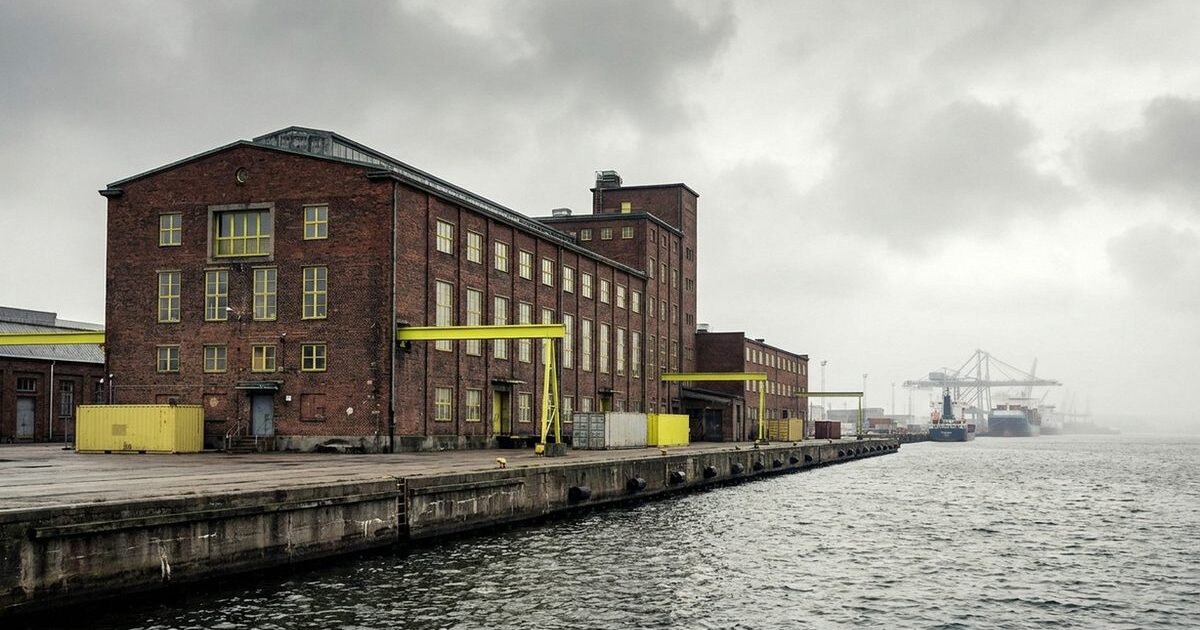
Gothenburg is Sweden’s second-largest city — population around 600,000 — with a biennial that has run since 2001, a sound-art festival founded the same year as the Tate Modern opened, an artist-run studio complex occupying a former epidemic hospital, and an arts academy that predates the university it now belongs to. It appears in zero of the nine comparative analyses of European media art scenes this site has reviewed. This article is the first attempt to map it.
Why Göteborg Has Been Underdocumented
The absence of Göteborg from the comparative record is not evidence of an empty scene. It reflects a specific structural gap in how European media art discourse circulates.
Three factors seem to converge. First, language. Gothenburg’s art scene communicates primarily in Swedish — event descriptions, critical writing, institutional newsletters. The English-language footprint is thin not because the scene is small but because nobody has built the documentation infrastructure that would make it searchable internationally. Helsinki has AV-arkki, which has been indexing Finnish media art in an internationally accessible database since 1989. Gothenburg has nothing equivalent.
Second, institutional branding. Röda Sten Konsthall and GIBCA are significant institutions within Swedish contemporary art — but neither carries the kind of international NMA-specialist identity that V2_ in Rotterdam or AV-arkki in Helsinki carry. They are contemporary art institutions that include time-based and sound work. That is not the same as being positioned primarily as media art venues. The distinction shapes what shows up in comparative analyses written from a media art perspective.
Third, the Stockholm gravity problem. Swedish cultural journalism and critical writing concentrate in Stockholm. Gothenburg has its own active scene — but the reflexive institutions that would document it and produce the international discourse output are thinner on the ground. What happens in Gothenburg tends to stay in Gothenburg, or to reach the English-language internet only when Stockholm-based writers pay attention to it.
None of this adds up to an absent scene. It adds up to an underdocumented one. The distinction matters, especially for comparative research. Göteborg has infrastructure. What it lacks is the narrative consolidation — not the substance.
GIBCA — Gothenburg International Biennial for Contemporary Art
GIBCA has run every two years since 2001. That is thirteen editions as of 2025. It is one of Sweden’s largest recurring contemporary art events, and it is almost entirely absent from European media art literature.
The biennial was initiated by the Gothenburg City Cultural Committee. Since 2006, Röda Sten Konsthall has served as the organizing institution — a shift that embedded the biennial more firmly in Gothenburg’s independent art infrastructure rather than in municipal administration.
GIBCA invites international curators for each edition, with a mandate to engage with the histories and contemporary situation of Gothenburg and the west of Sweden. The format is site-specific and expansive: major exhibitions at established institutions (Röda Sten, Göteborgs Konsthall, the Gothenburg Museum of Art) run alongside public realm installations and a regional partner network. Since 2013, this partner dimension has been formalized as GIBCA Extended — an open network of art organizations in the region that the biennial facilitates and coordinates.
The 2025 edition, curated by Christina Lehnert, ran September–November with the title “a hand that is all our hands combined” — a phrase drawn from a poem by Solmaz Sharif. Artists in the 2025 edition included practitioners working with moving image, sound installation, and video within sculptural structures. That is media art by any practical definition, though the biennial does not frame itself using that terminology.
Whether GIBCA has historically been a significant venue for new media art specifically — as opposed to contemporary art that sometimes uses time-based and digital formats — requires more granular research through the full archive of past editions. That research has not been done in any of the nine sources analysed for this site’s European scenes overview. It is an open question, not a confirmed gap.
Röda Sten Konsthall — Industrial Venue, Cross-Genre Programme
The building was a coal and wood-chip boiler house in 1940. It heated the industries of Klippan. By the early 1990s, artists and graffiti writers were using it for events and concerts. That informal use is the origin of the konsthall.
The formal turn came in September 1994, when thirty-seven artists from the Majorna neighbourhood exhibited in the space under the name Kulturprojekt Röda Sten. The building was then renovated between September 1999 and October 2000 — and it reopened as Röda Sten Konsthall. In 2001, the first GIBCA took place. The two histories are entangled from the start.
Röda Sten is a member of Trans Europe Halles, the European network of independent cultural centres. That membership places it in a broader infrastructure of non-governmental cultural spaces — alongside Konstepidemin (also a TEH member), but distinct from the media-art-specialist networks like EMAP.
The programming is explicitly cross-genre. The venue describes its exhibition programme as spanning paintings, photography, performances, video art, and sound art across its four floors. The 2015 exhibition “Reverberations” — documented in the venue’s Wikipedia article — explored sound’s relationship with form, space, and memory. Past exhibitions have included work by Julian Rosefeldt and Phil Collins, both artists whose practice centres on moving image and time-based installation. These are not isolated examples of media art at Röda Sten; they are consistent with a programming philosophy that treats the moving image and sound as standard exhibition formats rather than specialist additions.
What is not documented: whether Röda Sten has specifically commissioned or developed media art works, whether it has any lab infrastructure or production capacity for time-based work, and whether it has any formal relationship with technology-focused artist communities in Gothenburg. The venue presents itself as an exhibition and programming space — not as a production lab or residency facility for media artists specifically.
HDK-Valand — The Art Academy Research Line
HDK-Valand’s precursor institutions are older than the University of Gothenburg itself. The Drawing School that became Valand was founded in 1865. The School of Design and Crafts traces back to 1848.
The current merged form — HDK-Valand Academy of Art and Design — came into existence on 1 January 2020, combining the School of Design and Crafts (HDK) with what had been Valand Academy since 2012. Valand Academy itself was a 2012 merger of the Valand School of Fine Art with the School of Film Directing, the School of Photography, and the Department of Literary Composition. All of this is now one institution, part of the Faculty of Fine, Applied and Performing Arts at the University of Gothenburg.
The programmes relevant to media art context: Film (MFA), Photography (MFA), Fine Art (MFA), and Design — including an MFA with Embedded Design specialisation. The film and photography programmes are practice-based, leading to Master of Fine Arts degrees, taught in English. Ruben Östlund — director of “Force Majeure” and “Triangle of Sadness” — is among the notable alumni from the film programme, which establishes the level of international recognition the moving image department carries.
There is no named media art programme, interactive art programme, or new media specialisation visible in the current curriculum. This is a meaningful distinction. IAC Malmö (Inter Arts Center at Lund University) explicitly positions itself around technology-oriented cross-disciplinary practice; Aalto MediaLab in Helsinki has a long-established media art and design track. HDK-Valand’s film and photography programmes engage with contemporary practice — and practice-based fine art education routinely encompasses installation, video, and digital work — but the institutional framing does not emphasize media art as a distinct field in the way Aalto or IAC do.
Whether individual faculty or research lines at HDK-Valand engage specifically with new media, interactive, or technology-based artistic research is an open question. The institution’s research profile, doctoral programme focus, and individual studio faculty would need direct verification to answer it. That verification has not been done for this article.
GAS Festival — Göteborg Art Sounds
Founded in 1999, GAS is Sweden’s largest festival for sound art, modern composition, improvisation, and electronica. That founding year makes it a contemporary of Pixelache Helsinki (2002) and places it squarely within the late-1990s moment when sound art festivals emerged across northern Europe as a distinct format.
The festival is not a concert series. Performances are interwoven with sound installations; pre-recorded compositions sit alongside live improvisation; workshops, public talks, and seminars run alongside the programming. The 2024 edition presented artists from eleven countries across twelve venues in and around Gothenburg — among them Skeppet and Oceanen. New artistic directors took over from 2024: Stefan Klaverdal, a Swedish composer and sound artist, and Clara de Asís, a composer and producer working in experimental and electronic music based between Spain and the Netherlands.
Historically documented participants include Laurie Anderson, Kim Gordon, Phill Niblock, William Basinski, Keith Rowe, Maja Ratkje, and Kangding Ray — a roster that signals a festival positioned at the intersection of contemporary composition, free improvisation, electroacoustic work, and experimental electronics. GAS TV, the festival’s video archive, documents past editions.
The connection between GAS and visual or media art is not extensively documented in available sources. Sound installation crosses into media art territory by almost any definition — the festival’s explicit inclusion of sound installations alongside live performance suggests some overlap. Whether GAS has collaborated with media art institutions in Gothenburg, whether it has drawn visual artists working with sound into its programming, or whether it sees itself as part of a broader media art ecosystem in Gothenburg rather than a music festival with experimental ambitions — these are not answered by the sources available here. Konstepidemin hosts GAS opening events, which suggests at least an infrastructural connection to the broader artist community in the city.
Research Notes — What Remains to Be Mapped
This section is the honest accounting. Here is what this article does not know, and what a more thorough primary research effort would need to address.
The artist-run layer in Gothenburg is only partly visible from this research. Konstepidemin, the artist-run studio complex founded in 1987 on the site of Gothenburg’s former Epidemic Hospital, houses over 130 artists from diverse disciplines — visual artists, musicians, filmmakers, sculptors, writers, actors. It has run an artist-in-residence programme since 1990, accepting 15–20 international artists, writers, musicians, and curators annually. It is a Trans Europe Halles member. This is a substantial artist-run infrastructure — comparable in scale and character to the Piknik Frequency / Pixelache network in Helsinki. But whether Konstepidemin has a specific media art layer, whether any of its 130+ artists work in interactive, new media, or technology-based practice, and whether it has any functional relationship with GAS Festival or GIBCA on a media art axis — none of this is documented in available external sources. Konstepidemin’s own programming (Galleri Konstepidemin, Konstepidemin Scen) would need direct investigation.
There are additional artist-run galleries operating in Gothenburg that have not been researched for this article. Galleri 54 — artist-run since 1959 — maintains a “Videoteket,” a collection of video works accessible at the gallery. That is a low-profile but concrete media art infrastructure indicator. Galleri Box is another artist-run contemporary art space. Galleri Résistance. The picture is likely richer than this article can map with confidence.
The Malmö connection is under-researched. Gothenburg and Malmö are around 280 kilometres apart by road — roughly 2.5 hours by train on the west coast line. They are both significant Swedish cities outside Stockholm, both with university art academies, both with active artist-run layers. Whether artists move between them, whether the scenes share networks or remain largely separate, whether Gothenburg artists appear in Malmö shows and vice versa — none of this is documented in the sources available here. The 40-minute Malmö-Copenhagen corridor makes Malmö’s international connectivity structurally different; Gothenburg sits closer to Oslo than to Stockholm, which raises the question of a west-coast Nordic axis (Gothenburg-Oslo) that has not been examined in any of the nine comparative sources this site reviewed.
Göteborgs Konsthall is in transition. Founded in 1923 for Gothenburg’s 300th anniversary, it has programmed contemporary art for a century — including video art and installation. In 2025 it vacated its long-standing premises at Götaplatsen. It plans to reopen at Slakthuset in the Gamlestaden district in 2027. What happens to its programme during the hiatus, and what the move means for its role in the scene — including its role as a GIBCA co-presenter — is not clear from available sources.
Göteborg konstmuseum (the Gothenburg Museum of Art) has collected video art over the past twenty years — the museum has documented this in exhibition format. That is a collecting infrastructure that suggests some degree of institutional engagement with time-based work. The depth of that collection and its relationship to contemporary media art practice would need verification.
What this article can say with confidence: Gothenburg has more media art-adjacent infrastructure than any comparative analysis of European NMA scenes has acknowledged. The boiler house at Klippan, the sound art festival running since 1999, the biennial since 2001, the artist-run complex since 1987, the art academy with roots in the nineteenth century — these are not traces of a vanished scene. They are active institutions. The documentation gap is real. So is the scene.
Frequently Asked Questions
Why is Göteborg less documented in media art discourse than Malmö or Stockholm?
Three factors converge: the scene communicates primarily in Swedish, reducing its English-language footprint; its institutions (Röda Sten, GIBCA) are positioned as contemporary art rather than NMA-specialist venues, so they fall out of media art-specific literature searches; and Stockholm-centric Swedish cultural journalism underrepresents what happens in Gothenburg. None of this reflects an empty scene. Helsinki’s visibility in international NMA discourse is substantially built on AV-arkki’s documentation infrastructure, which has no equivalent in Gothenburg.
What is GIBCA?
GIBCA is the Gothenburg International Biennial for Contemporary Art. Founded in 2001, it takes place every two years with an international curator invited to develop a programme engaging with Gothenburg and the west of Sweden. Röda Sten Konsthall has organized the biennial since 2006. GIBCA Extended, established in 2013, is an open regional network of art organizations that the biennial facilitates alongside its main institutional programme. Thirteen editions had been held as of the 2025 edition.
What kind of venue is Röda Sten Konsthall?
Röda Sten is a contemporary art konsthall occupying a former industrial boiler house built in 1940 in the Klippan district of Gothenburg. Informal cultural use began in the early 1990s; the venue was renovated and reopened formally in October 2000. It programs paintings, photography, performances, video art, and sound art across four floors. It is a member of Trans Europe Halles, the European network of independent cultural centres, and has organized GIBCA since 2006. It is not positioned as a media art specialist institution but as a cross-genre contemporary art venue.
Does HDK-Valand teach media art?
HDK-Valand — Academy of Art and Design at the University of Gothenburg, formed through a 2020 merger — offers MFA programmes in Film, Photography, Fine Art, and Design, among others. There is no named media art or interactive art programme in the current curriculum. Film and photography programmes engage with contemporary moving image practice, and fine art education regularly encompasses installation and digital work, but the institutional framing does not position HDK-Valand as a media art academy in the way Aalto MediaLab or Inter Arts Center Malmö do. Whether individual research lines engage with technology-based practice requires direct verification with the institution.
What is GAS Festival?
GAS — Göteborg Art Sounds — is a festival for sound art, modern composition, improvisation, and electronica that has run in Gothenburg since 1999. It describes itself as Sweden’s largest festival in these fields. The 2024 edition presented international artists from eleven countries across twelve venues. Programming combines live performance with sound installations, workshops, and public talks. Past participants include Laurie Anderson, Phill Niblock, William Basinski, Maja Ratkje, and Keith Rowe. New artistic directors — Stefan Klaverdal and Clara de Asís — took over from 2024.