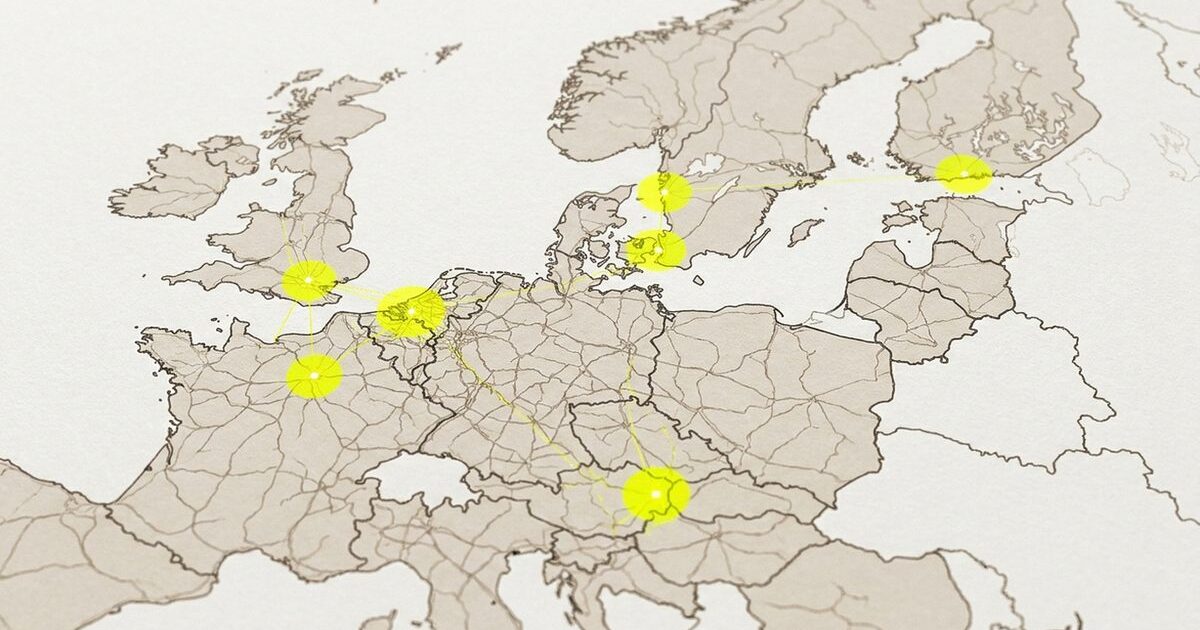
Four cities, four infrastructure models — and Gothenburg is absent from every comparative overview I have encountered. This article maps Helsinki, Malmö, Rotterdam, and Vienna against five dimensions: institutional anchors, artist-run ecology, funding structure, scene density, and documentation infrastructure. Gothenburg gets its own section, because absence from the record is itself a finding worth examining.
Why Non-Major Cities? Method and Field Definition
Non-major cities in the European new media art context are not smaller versions of Berlin or London. They are distinct structural formations — and conflating them misreads the field entirely.
A working definition: a non-major city for the purposes of this analysis has no established biennale brand of its own (no Documenta, no Venice Biennale franchise, no Biennale of Sydney equivalent), yet sustains active media art infrastructure across at least two of the following: institutions, festivals, artist-run spaces, and academic programmes. This excludes Linz — Ars Electronica has become a globally recognized brand that fundamentally reshapes what the city represents in the field. Linz is no longer a non-major city in NMA terms; it is a destination.
The four primary cities in this overview were selected on four criteria: documented field activity over at least fifteen years, verifiable institutional presence, some degree of international network connectivity, and — critically — existing published record, however partial. Gothenburg enters as a fifth case precisely because it fails the last criterion. Zero published comparative analyses include it. That gap is the data.
What this article does not do: rank cities, recommend residency destinations, or produce a tourism guide. The intent is analytic. Which structural model has produced the most durable infrastructure? Which is most vulnerable to a single funding decision? Where does the scene exist primarily in artists’ organizational capacity rather than institutional backing? These are the questions that matter for anyone trying to understand where European new media art actually lives — as opposed to where it gets celebrated at flagship events.
One methodological note on sources: the published record for these scenes is uneven. Helsinki benefits from AV-arkki’s systematic documentation since 1989. Malmö has been written about journalistically, if sporadically. Rotterdam documentation is heavily mediated through V2_’s own publishing output. Vienna exists almost entirely in festival-format announcements. Gothenburg barely appears at all. This unevenness is itself a finding; the article tracks it explicitly rather than papering over it with false equivalence.
Infrastructure Matrix: Institutions, Festivals, Artist-run Spaces, Academies
Before going city by city, a structural overview — what each scene has, and in what combination.
| City | Key Institution | Festival | Artist-run Spaces | Academy / University |
|---|---|---|---|---|
| Helsinki | AV-arkki (1989), Kiasma (1998), m-cult | Pixelache (2002) | Piknik Frequency ry + ~8 member orgs | Aalto University, UNIARTS Helsinki |
| Malmö | Moderna Museet Malmö (2009), Malmö Konsthall | Gallerinatten / Gallerihelg (annual) | Signal, Celsius Projects, Alta Art Space, Canopy, Trumpeten, Hangaren, Lilith Studios (~7 identified) | Malmö Art Academy (Lund University), IAC (2010) |
| Rotterdam | V2_ Lab for the Unstable Media (1981) | DEAF (Dutch Electronic Art Festival) | Not independently verified beyond V2_ | Rotterdam University of Applied Sciences |
| Vienna | Kunsthalle Wien, Foto Arsenal Wien | Vienna Digital Cultures (2025, first edition) | Not fully documented in available sources | Universität für Angewandte Kunst (Angewandte) |
| Gothenburg | Röda Sten Konsthall, Göteborgs Konsthall | GIBCA (biennial, est. 2001) | Not documented in available sources | HDK-Valand (Gothenburg University) |
The table reveals the structural split immediately. Rotterdam and Helsinki each have one dominant institutional anchor around which other activity orbits. Malmö is the outlier: the institutional presence (Moderna Museet Malmö, Malmö Konsthall) is significant but does not dominate the scene the way V2_ dominates Rotterdam. Seven artist-run spaces identified in a city of around 350,000 residents is a remarkably high ratio.
Vienna’s festival-orientation becomes visible here: its primary festival, Vienna Digital Cultures, launched its first edition only in 2025. That is not weakness — the Kunsthalle Wien has been programming digital art for years — but it signals that the city has not institutionalized a recurring festival-format anchor in the way Pixelache has for Helsinki since 2002.
Gothenburg’s column points to what’s missing. The infrastructure exists in outline — Röda Sten, GIBCA, HDK-Valand — but the NMA-specific activity within those institutions is poorly documented externally. That is the core problem this article addresses in H2.7.
Helsinki: Documentation as Infrastructure
AV-arkki, founded in 1989, is the oldest argument for why Helsinki leads the documentation comparison.
The Finnish Museum of Contemporary Art Kiasma opened in 1998 — a significant institutional anchor for new media and video art in a city that had been building infrastructure for a decade before the museum’s doors opened. AV-arkki, the nonprofit distribution and archive association for Finnish video and media art, predates Kiasma by nearly a decade. Founded in 1989, it created an online database to distribute and give visibility to Finnish artists working in video and media — a function that most European cities still have not institutionalized comparably.
m-cult operates as a research platform and festival bridge, part of a network of associations working for the development of Finnish media art. The organization has been a consistent connector between academic research and practitioner communities, though its current activity level — post the MEHI project — warrants verification before citing it as actively programming.
Pixelache launched in 2002. Technically the registered association is Piknik Frequency ry, with Pixelache as the working name. As of August 2024, the association had approximately 40 active members — a number that puts Malmö’s artist-run density claim in comparative context. Pixelache’s fields of interest are deliberately broad: experimental interaction and electronics, code-based art, grassroot organising, renewable energy, participatory art, open-source cultures, bioarts, alternative economy. This breadth is both a strength and a signal that the organization positions itself as a transdisciplinary platform rather than a pure NMA festival.
The MEHI project — Media Art History in Finland — ran from 2021 to 2023. Initiated by the Finnish Media Art Network, with Pixelache on the network board, it aimed to record and publish Finnish media art history and build information infrastructure for future documentation. MEHI is finished. What it left behind — the documented history, the infrastructure it began building — represents a qualitative advance in Helsinki’s documentation position that has no direct equivalent in Malmö, Rotterdam, or Vienna.
The language dimension is real and underexamined. Finnish and Swedish are both operative languages in Helsinki’s art scene, with Finnish dominant. This creates a soft barrier for international artists and researchers who arrive speaking English: event descriptions, organisational communications, and historical documentation exist in Finnish first. The AV-arkki database bridges some of this, but the bilingual reality of the Finnish scene means that the international record underrepresents what the scene actually contains.
Scene density characterization: hybrid. Strong state-funded institutional backbone (Kiasma, AV-arkki with public support, UNIARTS and Aalto as academic infrastructure) combined with a genuine artist-run layer in Pixelache and its member organizations. Neither purely institutionalized nor purely precarious.
Malmö: The Artist-run Density Case
Per capita, Malmö has the densest artist-run infrastructure of any city in this comparison. That claim deserves both the emphasis and the caveat.
The institutional history starts with the Rooseum, which operated as a contemporary art centre in Malmö under director Charles Esche from 2000 to 2006 — a period that produced international exhibitions and significantly raised the city’s profile. In late 2009, Moderna Museet Malmö took over the Rooseum facilities, shifting the space from an independent contemporary art centre to an offshoot of the Stockholm national museum. The curatorial agenda changed: Moderna Museet Malmö combines contemporary programming with the large Stockholm collection. It is a different institutional animal from the Rooseum it replaced.
Malmö Konsthall provides a complementary institutional presence: free entry, pavement-level access, programming that has historically supported experimental work. Neither the Konsthall nor Moderna Museet Malmö is specifically a media art institution — but both provide exhibition infrastructure that media and digital artists have used.
The artist-run layer is where Malmö distinguishes itself. Signal — Centre for Contemporary Art — is internationally recognized for its exhibition quality. Celsius Projects operates as a studio collective with an exhibition programme; the 2021 Gallerihelg documentation shows Rut Karin Zettergren’s VR work Nightboon in residence there. Alta Art Space, in a former ketchup factory on Celsiusgatan, functions as a project space. Canopy, which opened in 2020, is another artist-run gallery. Trumpeten — a studio collective that formed in direct response to a 2015 flood that destroyed equipment and studios — has been producing seminars, exhibitions, and debates from a former commercial storefront. Hangaren, an industrial building on Ystadsgatan, has been used for large-scale graffiti and mural works since 2013, expanding into installations and performances. Lilith Studios, active since 2007, invites four artists per year to produce large-scale performances. Seven distinctly identified artist-run spaces in a city of 350,000 residents.
Inter Arts Center (IAC) adds the academic layer. Established in 2010 and located in the former Mazetti chocolate factory in central Malmö, IAC operates as part of Lund University’s Faculty of Fine and Performing Arts, in direct dialogue with Malmö Art Academy, Malmö Academy of Music, and Malmö Theatre Academy. It focuses explicitly on technology-oriented art and cross-disciplinary projects. IAC is not a festival or a gallery — it is research infrastructure, with sound, video, and artist studios, alongside venues for performances, installations, and screenings.
The Elastic problem: the gallery Elastic, which promoted conceptually strong Malmö-based artists and participated in international art fairs, moved to Stockholm. Kalle Brolin’s 2015 analysis in La belle revue flagged this as a warning signal — when commercial gallery infrastructure leaves, what replaces it? A decade on, the answer appears to be: more artist-run spaces, not a new commercial gallery of equivalent profile. Whether that represents resilience or precarity depends on your model for sustainable scene infrastructure.
Political context matters here. Malmö has one of the highest segregation indices in Sweden — in both housing and employment. The same infrastructure investment and creative-class rhetoric (following Richard Florida’s model) that drove the Rooseum era and the university expansion also failed to address structural inequalities. Artists organize partly in response to this contradiction: Woodpecker Projects’ 2014 exhibition on xenophobic hatred, solidarity work with EU migrants in the city, the politicized openings during election campaigns. The scene is not aesthetically isolated from its city’s social fractures.
Scene density characterization: dense, artist-run-dominated. More organizationally dispersed than Helsinki, less institutionally concentrated than Rotterdam.
Rotterdam: The V2_ Monoculture Hypothesis
Rotterdam is the institutionally concentrated scene — everything gravitates toward V2_.
V2_ Lab for the Unstable Media was founded in 1981, making it the oldest institution in this comparison by nearly a decade. Its founding preceded Kiasma by seventeen years. V2_ presents, produces, archives, and publishes art created with new technologies — an integrated model that combines lab functions, residency programme, archive, and publisher under one roof. The Dutch Electronic Art Festival (DEAF) grew out of V2_’s Manifestations for the Unstable Media events, which began in 1987. V2_ celebrated its fortieth anniversary with a publication in 2021.
V2_ is one of the 16 partner organisations of EMAP (European Media Art Platform), the Creative Europe-funded residency network initiated by werkleitz and active since 2018. This means Rotterdam holds a confirmed node in the most significant active European NMA network — an advantage Helsinki also holds through Pixelache, but which Malmö, Vienna, and Gothenburg do not definitively share based on available sources.
The honest question: what else is there in Rotterdam? The available sources don’t clearly identify media-art-specific artist-run spaces operating independently of V2_. This is not a claim that nothing exists — it may simply reflect a documentation gap, or it may reflect the structural reality that V2_’s gravitational pull is strong enough to absorb activity that would otherwise cohere around independent spaces. Rotterdam’s contemporary art scene more broadly includes institutions like Witte de With (now Kunstinstituut Melly), but their NMA-specific programming is distinct from V2_’s focus.
The monoculture hypothesis is a structural risk framing, not a criticism of V2_. An institution that has operated for over forty years with significant international visibility is not fragile in the ordinary sense. But it means the Rotterdam scene’s resilience depends almost entirely on one institution’s continued funding and programming choices. Remove V2_, and it is genuinely unclear what the Rotterdam media art scene would be. Malmö’s seven artist-run spaces would survive the loss of Moderna Museet Malmö as a scene — bruised, but structurally intact. Rotterdam’s equivalent scenario is harder to imagine.
Scene density characterization: institutionally concentrated. High international impact, low internal redundancy.
Vienna: Festival-Oriented and Seasonally Active
Vienna organizes new media art activity primarily through festival formats — which makes it seasonally intense and permanently thin.
Vienna Digital Cultures launched its first edition from 6 to 18 May 2025, jointly organised by Foto Arsenal Wien and Kunsthalle Wien. The curatorial theme was Model Collapse — a term from machine learning that refers to the degradation of model diversity when training data loops back on itself, used here as a metaphor for cultural and ecological crisis. The exhibition at Kunsthalle Wien Karlsplatz featured five artists (Eva and Franco Mattes, Joey Holder, Kate Crawford and Vladan Joler, Arvida Byström, Mathias Gramoso), with the festival extending across Angewandte Interdisciplinary Lab, Haus der Republik, REAKTOR, and PRST.club over the two-week run.
This is a first edition. Vienna Digital Cultures may develop into a recurring annual anchor — or it may remain a one-off experiment depending on funding and institutional appetite. The Kunsthalle Wien has programmed digital art as part of its regular programme, but the explicit festival branding around Vienna Digital Cultures represents a new structural move: positioning Vienna in the map of European NMA festival cities rather than relying on institutional programming alone.
Ars Electronica requires an explicit clarification here. Ars Electronica is based in Linz, not Vienna. The two cities are roughly 180 kilometres apart. The conflation appears persistently in casual writing about Austrian digital art, and it misrepresents both cities: it overcredits Vienna’s NMA infrastructure and undercredits Linz’s entirely separate institutional identity. Vienna is not a Ars Electronica city. Vienna is building its own distinct festival infrastructure through Vienna Digital Cultures.
The artist-run landscape in Vienna’s media art context is not well-documented in the available source set. The Angewandte (Universität für Angewandte Kunst Wien) is the primary academic anchor — its Interdisciplinary Lab served as a festival venue for Vienna Digital Cultures 2025, which suggests active institutional collaboration. But the grassroots layer between the institutional and festival poles is, at this point, a research gap rather than a confirmed absence.
Scene density characterization: festival-oriented, seasonally active, permanently thinner than Helsinki or Malmö in terms of artist-run infrastructure. The strongest institutional programming of any city here — Kunsthalle Wien has a serious international reputation — but organized around exhibition programming rather than the year-round residency/lab/community model that Helsinki and Rotterdam represent.
Gothenburg: A Preliminary Map and Open Questions
Gothenburg does not appear in any of the nine comparative sources analysed for this article. That is not coincidence. It is a documentation failure, and distinguishing it from absence of activity is the task here.
What can be stated with confidence, based on verifiable sources:
GIBCA — Gothenburg International Biennial for Contemporary Art — has been running since 2001. It is biennial, held every two years, and has established an open partner network called GIBCA Extended since 2013. GIBCA invites international curators and features major exhibitions at established Gothenburg institutions alongside public realm installations. Its contemporary art programming has not been described in available sources as specifically media art-focused, but biennial formats in this scale regularly include time-based and digital work.
Röda Sten Konsthall is an art venue occupying a former industrial building in Gothenburg. Its programming includes video art and sound art alongside painting and photography — medium-agnostic programming that is consistent with contemporary art practice but does not signal a dedicated NMA institutional mandate. The founding date of the venue is not confirmed in the sources available for this article.
HDK-Valand — the Academy of Design and Crafts and the Academy of Fine Arts, merged within Gothenburg University — is the primary academic infrastructure. The academy runs programmes in fine arts, film, photography, and design. Whether it has dedicated media art or interactive art programmes comparable to Aalto MediaLab or IAC Malmö requires direct verification with the institution.
What is hypothesis and needs verification before this article is published:
Gothenburg has a documented electronic music and experimental sound scene. The relationship between this scene and media art practice — sound art, audio-visual installation, live coding — is a plausible connection based on how these communities interact in comparable cities (Malmö, Helsinki), but it has not been documented in available sources for Gothenburg specifically.
The proximity question: Gothenburg and Malmö are approximately 280 kilometres apart by road, roughly 2.5 hours by train. This is not the 40-minute Malmö-Copenhagen corridor, but it does place them within the same Swedish west-coast cultural geography. Whether Gothenburg and Malmö artists share networks, move between cities, or operate in largely separate scenes is not documented in available sources.
Why does the documentation gap exist? Three plausible factors: language (Gothenburg’s scene communicates primarily in Swedish, reducing its international English-language footprint); institutional profile (Röda Sten and GIBCA are significant but neither has the international NMA-specialist branding of V2_ or AV-arkki); and timing (a city whose scene developed strongly in the 2010s would appear less in pre-2015 literature that shapes current search infrastructure). None of these explanations is fully satisfying. The gap is real and worth addressing with primary research that this article cannot substitute for.
Scene density characterization: Unverified. Preliminary map suggests institutional presence (Röda Sten, GIBCA, HDK-Valand) without documented NMA-specific density. This section documents what can be said and marks the rest clearly as open questions — that framing is more useful than false completeness.
Comparative Matrix: Density, Funding, Documentation, Politics
Which model is most resilient against funding cuts? The answer is structural, not a matter of institutional quality.
| Dimension | Helsinki | Malmö | Rotterdam | Vienna | Gothenburg |
|---|---|---|---|---|---|
| Scene Density | Hybrid | Dense, artist-run-dominated | Institutionally concentrated | Festival-oriented, seasonal | Not documented |
| Funding Model | State + artist-run mixed | Mixed: public, university, artist-run | Institutionally dominated (V2_) | Festival + public institutional | Not documented |
| Documentation Infrastructure | Strong (AV-arkki since 1989, MEHI 2021–2023) | Medium (journalistic, IAC media archive) | Medium (V2_ archive and publishing) | Weak (festival-format announcements) | None identified |
| Artist-run Spaces | Present (Pixelache member orgs) | Dense (~7 identified) | Not independently verified | Not documented | Not documented |
| Political Risk Factor | Low | Medium (segregation tensions, creative-class contradictions) | Low | Medium (first-edition festival dependency) | Unknown |
| Academic Anchor | Strong (Aalto, UNIARTS) | Medium (Malmö Art Academy, IAC/Lund) | Medium (Rotterdam UAS) | Medium (Angewandte) | Present (HDK-Valand — depth unverified) |
| Historical Continuity | Long (AV-arkki 1989, Pixelache 2002) | Medium (Rooseum from 2000, artist-run from mid-2000s) | Long (V2_ from 1981) | Medium (Kunsthalle Wien long-standing, festival new) | Unknown |
The documentation row is the most revealing. Rotterdam’s V2_ archive is extensive — the publication list alone runs from 1992 through 2023 — but it documents primarily what V2_ itself has produced. The Helsinki AV-arkki model documents the field as a whole, not just one institution’s output. That distinction matters for the quality of the historical record. AV-arkki’s 1989 database was built specifically to give visibility to artists across the Finnish field; V2_’s publications are excellent institutional documentation but are not the same thing as a field-wide archive.
Vienna’s documentation weakness is almost entirely a function of the festival-format: festivals produce press releases, programme notes, and documentation after the fact, but rarely the kind of sustained, searchable, institutionally maintained archive that AV-arkki represents. Vienna’s contribution to the field’s self-understanding is real but dispersed.
The resilience question. Rotterdam has one institution. If V2_ faces a major funding cut — not implausible in the current European cultural funding climate — the Rotterdam scene loses its primary organizational capacity. Malmö’s seven artist-run spaces would each need to absorb a blow individually, but the scene as a distributed structure would survive. Helsinki’s hybrid model has multiple redundancy points: Kiasma, AV-arkki, Pixelache, IAC’s academic equivalent in Aalto and UNIARTS, all with separate funding streams.
Rotterdam has a one institution. Malmö has an ecosystem. Those are not two variants of the same model — they carry structurally different risk profiles. Dense and distributed is more robust against single-point failure. Whether it is more robust against the slow erosion of precarious artist-run funding over time is a different question.
The political risk dimension: Malmö’s segregation context (among the highest in Sweden) has shaped artistic organizing directly — politically motivated collectives, solidarity-oriented exhibitions, artists engaging city fractures rather than decorating them. This is generative tension, not catastrophic risk. Vienna’s Model Collapse framing is a different register: the festival’s own curatorial framing acknowledges systemic breakdown. Whether that translates into sustained critical programming beyond the first edition remains to be seen.
Historical timing shapes structural character in ways the matrix makes visible. V2_ was founded in 1981 — before the internet, before desktop personal computers were common, in the earliest years of what we now call media art as a field. It grew up with the field. AV-arkki in 1989 represents the same early-adopter institutional position in Finland. Pixelache in 2002 came after the internet but during the browser-art and early interactive period that this site documents elsewhere. Vienna Digital Cultures in 2025 arrives fully in the AI era. Each founding moment inscribes different assumptions about what media art is and what infrastructure it needs.
Network Map: EMAP, Reset!, Pixelache Connections
These are not isolated scenes. The network layer is where cities either amplify or limit their impact beyond their geography.
EMAP — European Media Art Platform — is the most significant active network for this comparison. Initiated by werkleitz and co-funded by Creative Europe since 2018, EMAP brings together 16 leading European organisations working in digital and media art, bio art, and robotic art. Each partner hosts two-month fully funded residencies, with artist fee, travel, production budget, accommodation, and lab access. Among the cities in this article, confirmed EMAP partners include V2_ in Rotterdam and m-cult in Helsinki. Vienna’s Kunsthalle Wien and Malmö’s IAC do not appear in the confirmed 2025/2026 EMAP partner list based on available sources.
EMAP partners identified in the 2025/2026 listings include: Ars Electronica (Linz), Chroniques (Marseille), CIKE (Košice), gnration (Braga), iMAL (Brussels), IMPAKT (Utrecht), Kersnikova Institute (Ljubljana), KONTEJNER (Zagreb), LABoral (Gijón), MEET (Milan), NeMe (Limassol), RIXC (Riga), WRO (Wrocław), Werkleitz (Saxony-Anhalt), ZKM (Karlsruhe), and the two relevant to this article: V2_ and m-cult. Pixelache in Helsinki has a relationship with EMAP through m-cult rather than as a direct partner.
Reset! Network: Pixelache joined the Reset! European Network for independent cultural and media organisations in June 2022. Reset! connects independent cultural associations and reinforces local networks by opening international contacts. Pixelache’s About page notes this explicitly. Whether Rotterdam, Malmö, Vienna, or Gothenburg organisations are Reset! members is not confirmed in available sources.
Pixelache’s own international connectivity is significant beyond EMAP. The 2022 Futureless Festival (Stockholm) brought Piksel (Norway) and Pixelache (Finland) together, both celebrating their twentieth anniversary in the same year — a Nordic art-and-technology festival axis that has been active since the early 2000s. This Nordic network is less formalized than EMAP but represents a real geography of collaboration: Helsinki, Bergen/Oslo, and the Stockholm experimental scene as connected nodes.
The connectivity picture for Gothenburg is, predictably, undocumented. GIBCA Extended is an open regional network of art organisations, but whether it includes NMA-specific members is not clear from available sources. Given Gothenburg’s geographic position — closer to Oslo than to Stockholm, within Sweden’s west coast cultural axis — it likely has connections to Norwegian new media communities that are simply not documented in the English-language sources this analysis draws on.
Network connectivity correlates with documentation depth, which correlates with international visibility. AV-arkki’s 1989 database, m-cult’s EMAP presence, and Pixelache’s Reset! membership all function as documentation infrastructure — they put Helsinki on the record in ways that are searchable, citable, and retrievable. The cities with the weakest network integration (Vienna as first-edition festival, Gothenburg as undocumented) are also the cities most likely to disappear from comparative analyses like this one. The map shapes what gets mapped.
Frequently Asked Questions
Which non-major city has the densest media art scene in Europe?
By the metric of artist-run spaces per capita, Malmö is the densest of the five cities analysed here. Approximately seven identified artist-run spaces in a city of around 350,000 residents — Signal, Celsius Projects, Alta Art Space, Canopy, Trumpeten, Hangaren, Lilith Studios — represent an organisational density that Rotterdam and Vienna do not match. Helsinki has a comparable artist-run layer through Pixelache’s member organisations (~40 members as of 2024), but spread across a larger metropolitan population. Dense is not necessarily the most important quality in a media art scene, however. Rotterdam’s V2_ generates more international impact per institution than Malmö’s distributed ecology. The density advantage trades off against impact concentration.
Where in Europe is the best documentation infrastructure for media art?
Helsinki, by a clear margin. AV-arkki, founded in 1989, is the only institution in this comparison that was built specifically to document and distribute the work of a national field — not just one institution’s output. The MEHI project (2021–2023) added historical depth to what AV-arkki has maintained as a living distribution archive. V2_ in Rotterdam has produced substantial documentation through its publishing programme, but that documents V2_’s own programming rather than the Dutch media art field as a whole. The AV-arkki model — a nonprofit, public-funded archive serving a national artist community — has no direct equivalent elsewhere in this analysis.
Which city is most strongly artist-run?
Malmö. The combination of Signal, Celsius Projects, Alta, Canopy, Trumpeten, Hangaren, and Lilith Studios gives the city a density of artist-organized space that is structurally different from Helsinki’s Pixelache model (one umbrella association with many members) or Rotterdam’s institutionally concentrated scene. The Malmö artist-run layer has demonstrable fragility: Elastic’s departure to Stockholm in 2015 was a real loss, and many spaces operate from precarious funding arrangements. But fragility and density can coexist — the question is whether the organizational capacity to keep rebuilding is present, and Malmö’s track record since 2015 suggests that it is.
Which networks connect European media art scenes?
The three most active networks linking the cities in this analysis are: EMAP (European Media Art Platform), the Creative Europe-funded 16-partner residency network connecting V2_ (Rotterdam) and m-cult (Helsinki) among others; Reset!, the European Network for independent cultural and media organisations, which Pixelache (Helsinki) joined in 2022; and the informal Nordic network connecting Pixelache, Piksel (Norway), and Stockholm-based organisations such as Futureless Festival. EMAP is the most institutionalised of the three, with formal residency funding and programme coordination. Reset! is more loosely structured, focused on mutual support and visibility. The Nordic network is the least formalised but represents a durable geography of practice that has been active since the early 2000s.
What makes Gothenburg relevant to a European media art overview?
Partly the infrastructure indicators: GIBCA (a biennial active since 2001), Röda Sten Konsthall (programming video and sound art), and HDK-Valand as an academic anchor all point to a scene with real activity. More fundamentally, Gothenburg’s relevance is an argument about the limits of the existing documentary record. A city of 600,000+ with documented arts institutions, a biennial, and a major university arts faculty does not simply lack a media art scene — it lacks a documented media art scene. Those are different problems. The Gothenburg case is the strongest argument this article makes for why non-major-city scenes need systematic documentation of the kind AV-arkki provides for Helsinki: not because the scenes don’t exist, but because undocumented scenes don’t travel, don’t attract residency applications, and don’t appear in comparative analyses that could amplify their work.