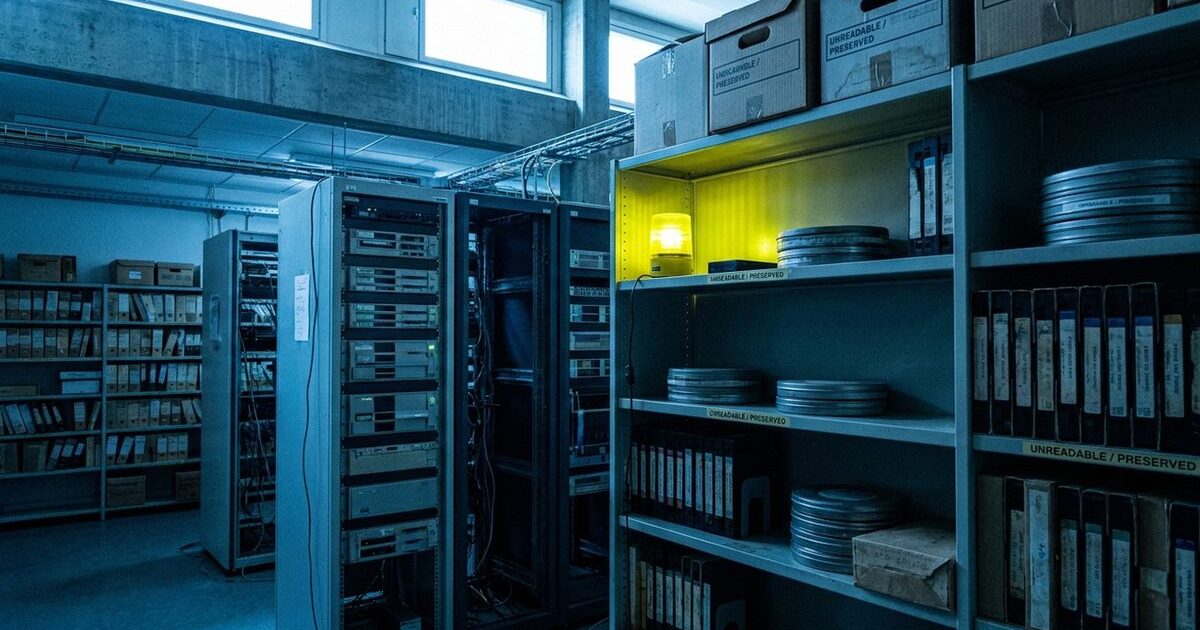
Sweden’s Kulturarw3 is the oldest complete national web archive in the world. It has been running since 1997. It holds more than 500 million web pages — over 5 billion individual files, approximately 350 terabytes of Swedish internet history. And it cannot play the Flash files it archived. That is the paradox this article is about.
What Kulturarw3 Is — And Why It Matters Historically
Kulturarw3 is not merely a Swedish project. It was the first systematic national web archive anywhere in the world — launched before most countries had considered the problem at all.
Kungliga biblioteket (KB) — Sweden’s national library, founded in 1661 — has been collecting legal deposit copies of printed Swedish works since the seventeenth century. The logic is simple and old: if it is published in Sweden, a copy belongs in the national collection. When the web arrived, KB extended that logic. In 1997, KB launched Kulturarw3, a programme to systematically crawl and archive the Swedish web. The name is a play on the Swedish word kulturarv — cultural heritage — and the HTML entity for the at-sign, reflecting both the cultural mandate and the digital medium.
The timing matters. 1997 was early. The Internet Archive had launched its Wayback Machine project in 1996, but its mandate was global and opportunistic rather than national and comprehensive. KB’s approach — crawl the entire .se domain as a cultural heritage obligation — was the first of its kind. Sweden positioned the web as a publishable medium subject to the same preservation logic as books, and it acted on that position before the web had become the dominant information environment it later became.
That institutional instinct was right. And it was not enough.
The Scale — 500 Million Pages, 5 Billion Files, 350 Terabytes
The numbers from KB’s own collection documentation are substantial. Kulturarw3 currently holds more than 500 million Swedish web pages. The total file count exceeds 5 billion. Storage runs to approximately 350 TB. These figures come from KB’s Webbpublicerat collection page, updated as recently as August 2025.
The crawling methodology is straightforward but labour-intensive. KB runs one to two general crawl sweeps per year, each lasting several months, targeting all domains in the .se space. Selective crawls of news media and political party websites happen more frequently — weekly or daily during election periods. The crawler operates from a defined IP range (193.10.72.193–193.10.72.222), and KB publicly documents how site administrators can throttle the crawler’s speed if needed.
What Kulturarw3 collects is not the live experience of a website. It collects snapshots — HTML files, linked assets, embedded media. The crawler follows links, downloads files, and stores what it finds at a given moment. That is not a criticism. It is exactly what web crawlers do. WARC (Web ARChive) format is the technical standard for storing these captures, developed through the International Internet Preservation Consortium (IIPC) — of which KB is a confirmed member, alongside Nasjonalbiblioteket in Norway, the National Library of Finland, the Royal Danish Library, and the National and University Library of Iceland. The Nordic national libraries are, collectively, among the most active participants in global web archiving infrastructure.
350 TB of Swedish web history. That is the scale. The question is what it contains — and what it does not.
The Paradox — URLs Preserved, Interactivity Lost
The archive is impressive in scope. It is also broken for interactive net art. Those two things are both true, and the tension between them is not accidental.
Here is the mechanism. A Flash-based net artwork from 2003 consists of several components: an HTML page, a SWF (Shockwave Flash) file containing the interactive logic and animation, possibly external data calls, and a runtime environment — the Flash Player — that executes the SWF. KB’s crawler, doing its job correctly, will have captured the HTML and the SWF file. Both are sitting in the Kulturarw3 archive. The URL is preserved. The file is preserved.
But the SWF file is not a document. It is a program. To experience what the work actually was, you need to execute it. And KB, from all publicly available documentation, has built no emulation layer into Kulturarw3 that would allow a researcher sitting at the dedicated terminal in Stockholm to run that SWF file in a Flash Player environment. The archive has the body. It does not have the heartbeat.
This is not a Flash-specific failure. It is a structural one. The web crawl model was designed to preserve the document web — HTML pages, text, images, the readable, static layer of internet publishing. Interactive environments were always outside that design intent. VRML, Java Applets, Shockwave Director pieces, early WebGL experiments — the crawl captures their container files. The runtime environments that give those files meaning are not part of the archive.
The oldest national web archive in the world cannot play its own Flash files. That is not a technical oversight. It is a philosophical one — a gap between what “archiving” was understood to mean in 1997 and what net art actually required.
Whether KB has since made any internal provision for Flash emulation — whether any work is being done to address this — is not answerable from publicly available KB documentation. KB’s Kulturarw3 page makes no mention of emulation, interactive content, or Flash. This is the author’s direct reading of the publicly available source, and KB has not published a statement addressing it. [Research note: this is the author’s assessment based on public documentation. Direct inquiry to [email protected] or on-site research at KB Stockholm is required to confirm definitively whether emulation capacity exists or is planned.]
For comparison: when the Internet Archive integrated Ruffle — a Flash emulator written in Rust and compiled to WebAssembly — into its Flash collection in November 2020, it gave users browser-native playback of archived SWF files without any plugin. That integration required a specific technical decision and development work. It did not happen automatically as a consequence of having archived the files. KB has not, publicly, made that decision.
E-Plikt 2013 — The Legal Mandate and Its Gaps
Sweden’s E-Plikt extended the legal deposit principle to digital publications in 2013. It did not fix the executability problem — and it was not designed to.
E-plikt — Sweden’s term for electronic legal deposit — came into force in 2013. KB had been given the mandate to collect and preserve Swedish material published in electronic form from 2012, and the formal deposit system began receiving material in 2013. The scope is defined by the concept of publication: publicly accessible online materials with a Swedish connection, including web-based articles, e-books, podcasts, films, and government publications.
The distinction between Kulturarw3 and E-plikt is architecturally important. KB documents it clearly: Kulturarw3 collects whole websites as snapshots. E-plikt collects individual published items — enskilda delar in the Swedish original. They are complementary but non-overlapping. Neither was designed with interactive executable environments as a primary category.
The coverage gap for net art is structural. An interactive Flash piece from 2004 is not a publication in the legal deposit sense. It has no ISBN or ISSN. It is not classifiable as an e-book or a web article. It functions as an executable environment, not a readable document. Under the current E-plikt framework, it falls outside mandatory deposit. Under Kulturarw3, its files may be captured — but not its executability.
Norway’s situation follows a comparable logic. Nasjonalbiblioteket has been crawling the .no domain since the early 2000s and is an active IIPC member. All five Nordic national libraries are IIPC members and participate in shared methodology development. But IIPC membership and WARC-format crawling solve the same problem KB’s crawls solve: they preserve files. They do not, by default, preserve the runtime environments those files require to function as art.
The case for revising E-plikt to include interactive digital environments as a distinct deposit category is direct and, currently, unaddressed.
Access Reality — On-Site Only in Stockholm
There is another dimension to the paradox, and it operates before the Flash problem even arises. Access to Kulturarw3 is physically restricted to KB’s reading room in Stockholm. There is no remote access. No API. No web interface available to the public.
To search the archive, you travel to KB, sit at a dedicated Kulturarw3 terminal, and enter a specific URL. Not a search term — a URL. If you want to find old versions of a particular Swedish art organisation’s website, you need to know the address already. The archive does not support free-text search. You cannot ask Kulturarw3 “show me all Swedish net art from 2002” because that is not how the system works. You ask it for a specific address and it tells you when snapshots exist.
This is not an obscure technical limitation. It defines the practical reality of Kulturarw3 as a research resource. A researcher in Helsinki, Oslo, or Gothenburg who wants to investigate what a particular Swedish artist’s website looked like in 2001 must arrange a visit to Stockholm. For international researchers, this is a significant barrier. For any researcher working with large-scale questions about Swedish net art as a category — rather than a specific known URL — the search model is structurally inadequate.
The access restriction reflects copyright law, not KB’s preference. Swedish copyright in archived web material prevents KB from making the archive freely accessible online, because doing so would constitute public performance of copyright-protected works without rights clearance. The national library is caught between its preservation mandate and the rights framework around the material it has preserved. That tension has not been resolved in any Nordic jurisdiction.
What Would It Take to Fix This?
Rhizome did it. The Internet Archive did it. The question is whether KB will.
The technical path exists. Rhizome’s partnership with the University of Freiburg’s Emulation as a Service (EaaS) framework — bwFLA, developed at Freiburg — provides cloud-based full operating-system emulation. A researcher accessing a Rhizome-hosted legacy artwork gets a remote browser session running genuine Flash Player on an emulated Windows environment from the relevant era. The fidelity is high. The cost is real: Rhizome’s preservation services for institutional clients range from $500 to $1,500 for initial assessment, with ongoing hosting fees. That is an institutional-scale expenditure.
The Internet Archive took a lighter-weight route. Ruffle — an open-source Flash emulator in Rust and WebAssembly — integrates directly into the browser. No cloud infrastructure. No server-side emulation. The SWF file runs natively in a modern browser through the WebAssembly runtime. Compatibility is not 100%: works using complex ActionScript 3 scripting, external data calls, or legacy browser integrations may not play correctly. Self-contained single-file pieces are the best candidates. But for a significant subset of archived Flash content, Ruffle makes the material accessible without specialist infrastructure.
KB could, in principle, integrate Ruffle into the Kulturarw3 terminal. The software is free and open source. The technical barrier is not the main obstacle. The main obstacle is institutional priority and the copyright question: does running a Flash emulator that executes archived SWF files, in a closed on-site environment for authorised researchers, constitute a permissible use under Swedish copyright law? That specific legal question has not been publicly answered. It probably needs to be asked, formally, before any technical solution can be deployed.
The Rhizome model and the Internet Archive model represent two different answers to the same problem: one institutional and expensive, one lightweight and browser-native. KB does not need to choose between them immediately. It needs to decide that the problem is worth addressing — that archiving the files is not the end of the obligation, that executability is part of the preservation mandate. That decision has not been made publicly.
Implications for Nordic Digital Heritage
The Kulturarw3 paradox is a Swedish case. But it maps directly onto every national library in the Nordic region that has been crawling web domains since the late 1990s or early 2000s.
All five Nordic national libraries are IIPC members. All five have been collecting web content for decades. None, from publicly available documentation, has implemented emulation infrastructure for interactive legacy content at the Kulturarw3 scale. The Nordic web archiving infrastructure is among the oldest and most comprehensive in the world — and it shares the same structural gap.
This matters for net art specifically because the Nordic region had an active browser-based and Flash-era art scene during the peak years of the medium. The Electrohype biennials in Malmö — six editions from 2000 to 2010, explicitly focused on computer-based and web-based art — documented work that was live and browser-dependent during exactly the period Kulturarw3 was archiving the .se domain. Whether the works exhibited at those events survive in executable form is an open research question. The files may exist in the archive. The experience of the work almost certainly does not.
Nordic institutions need interoperable emulation infrastructure — not just URL crawls. The IIPC provides the network and the shared methodology. The technical tools exist. What is missing is the institutional decision that preserving the web means preserving what the web does, not only what the web contains.
Frequently Asked Questions
What is Kulturarw3?
Kulturarw3 is Sweden’s national web archive, operated by Kungliga biblioteket (KB) — the National Library of Sweden in Stockholm. It began systematically crawling Swedish websites in 1997, making it the oldest complete national web archive in the world. The name combines kulturarv (Swedish for “cultural heritage”) with the HTML character code for the at-sign. The archive currently holds more than 500 million Swedish web pages, over 5 billion files, and approximately 350 TB of data. Access is restricted to an on-site terminal at KB Stockholm; there is no public remote access.
Why can’t Kulturarw3 play Flash files it has archived?
Kulturarw3’s web crawlers capture HTML files, SWF files (Adobe Flash’s binary format), and other linked assets — but they do not capture or emulate the runtime environment needed to execute Flash content. A SWF file is a program, not a document. Without a Flash Player or a Flash emulator running alongside the archived file, the SWF is inert data. KB has not, from publicly available documentation, built any emulation layer into the Kulturarw3 terminal that would allow archived Flash files to run. This is not a Flash-specific limitation: the same applies to Java Applets, Shockwave Director pieces, and other interactive formats from the same era that were captured as files but not as executable environments.
How can I access Kulturarw3?
You must visit Kungliga biblioteket in Stockholm in person. Access is available on-site during KB’s opening hours at the dedicated Kulturarw3 computer terminal. You search by entering a specific URL — not a free-text search term. The archive will show you which snapshots exist for that address and from which dates. There is no remote API or public online interface. The access restriction reflects Swedish copyright law: making archived web content freely available online would constitute public performance of copyright-protected material without rights clearance.
What is E-Plikt (Swedish digital legal deposit)?
E-plikt is Sweden’s system of mandatory deposit for electronic publications. KB began receiving e-plikt material in 2013, under a mandate established in 2012. The scope covers publicly accessible online publications with a Swedish connection — web articles, e-books, podcasts, films on the web, government publications. Unlike Kulturarw3, which captures whole websites, E-plikt collects individual published items. Interactive net artworks without an ISBN or ISSN, or those that function as executable environments rather than readable publications, fall outside the current E-plikt definition. Neither programme was designed to address the executability requirements of interactive digital art.
How does Kulturarw3 compare to the Internet Archive?
Both archive web content using WARC-format crawls, both preserve HTML and linked assets, and both restrict what their archives can deliver to researchers for copyright reasons. The key differences: Kulturarw3 is nationally scoped (the Swedish web, with comprehensive .se domain coverage), while the Internet Archive is global and opportunistic. On Flash specifically, the Internet Archive has integrated Ruffle — a Flash emulator built in Rust and WebAssembly — into its Flash collection, giving users browser-native playback of archived SWF files. Kulturarw3 has not, as of this writing, made an equivalent integration. The Internet Archive’s collection is also accessible remotely via the Wayback Machine; Kulturarw3 is on-site only.